Flat Rate VAT Scheme: Will You Pay Less Than Standard VAT?
A flat rate of 14.5% can look more attractive than paying 20% VAT. But those percentages apply to different amounts, and the flat rate VAT scheme also changes what you can reclaim on your purchases.


- Published on:
- 14 October 2026
- Last updated on:
- 16 October 2026
Table of contents
The scheme can save you money, but it is not automatically the cheaper option. Before recommending it, we would compare your VAT payments under both methods using your sales and expenses. The important figure is what you actually pay, not the percentage that initially looks lower.
What Is the Flat Rate VAT Scheme?
The Flat Rate Scheme (FRS) is an optional VAT accounting method for eligible VAT-registered businesses. It simplifies how you calculate your payment to HM Revenue & Customs (HMRC).
Under standard VAT accounting:
- you deduct reclaimable VAT on purchases, known as input VAT,
- from VAT charged to customers, known as output VAT.
Under FRS, you usually pay a percentage of your VAT-inclusive turnover instead. You normally cannot reclaim VAT on everyday purchases, so the amount you retain needs to compensate for the VAT recovery you give up.
How Does VAT Flat Rate Scheme Work?
You still charge customers the correct VAT rate for your goods or services. For standard-rated sales, that remains 20%. Your flat rate percentage only determines what you pay HMRC.
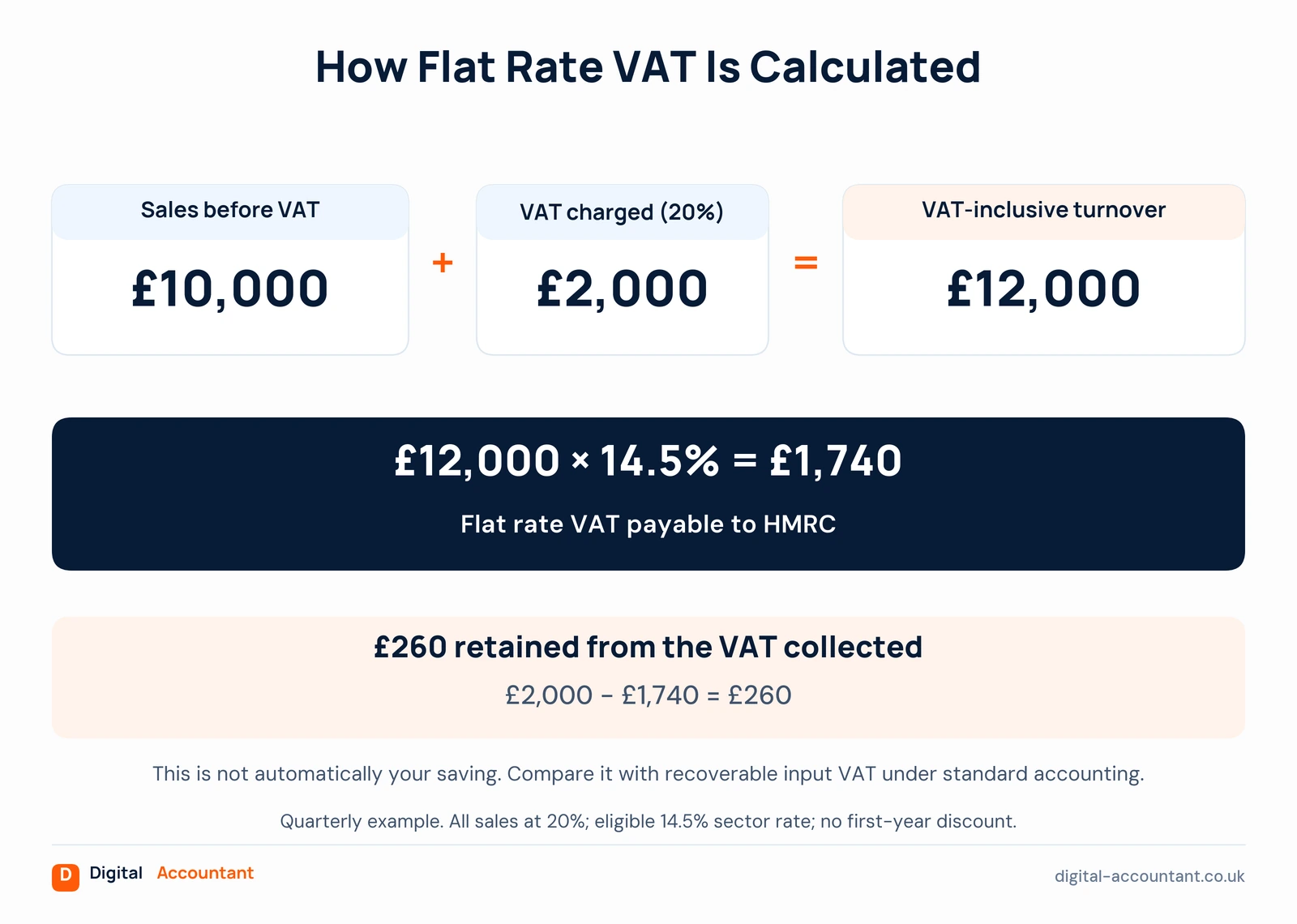
Suppose you make £10,000 of standard-rated sales in a quarter and charge £2,000 VAT. If you qualify for a 14.5% flat rate, your calculation is:
£12,000 VAT-inclusive turnover × 14.5% = £1,740 payable to HMRC
You apply the percentage to £12,000, not the £10,000 before VAT. This leaves £260 of the VAT collected, but that is not necessarily your saving. We need to compare it with the input VAT you could otherwise reclaim.
What Are the Flat Rate VAT Scheme Thresholds?
Before comparing the costs, check your eligibility. The scheme has separate joining and leaving limits, which are different from the £90,000 compulsory VAT registration threshold.
The £150,000 Joining Threshold and Eligibility Restrictions
You must be VAT registered and expect taxable turnover of £150,000 or less, excluding VAT, over the next 12 months. Include zero-rated sales, but exclude exempt income and expected capital asset sales.
This is a forecast, so account for new contracts and expected growth rather than relying entirely on last year’s figures.
Your turnover is not the only condition. You cannot join if you left FRS or committed certain VAT offences in the previous 12 months.
Restrictions also cover closely associated businesses and incompatible VAT schemes. VAT-group membership or eligibility and divisional registration within the previous 24 months can also prevent entry.
The £230,000 Leaving Threshold and Review Dates
Once you join, passing £150,000 does not automatically mean you must leave. Instead, check the previous 12 months’ turnover on each anniversary of joining.
If it exceeds £230,000 including VAT, you normally have to leave. Include exempt business income but exclude capital asset sales. For quarterly returns, you leave at the end of the VAT period containing that anniversary.
You must also leave if you expect turnover, excluding capital asset sales, to exceed £230,000 including VAT in the next 30 days alone. This takes effect from the beginning of that period.
After an unexpected one-off increase at the annual review, HMRC may allow you to stay if next year’s VAT-inclusive turnover will not exceed £191,500. You need HMRC’s agreement; this exception does not apply to the 30-day test.
Which Flat Rate VAT Scheme Percentage Applies to Your Business?
Your business activity identifies your sector rate. However, your spending on qualifying goods determines whether you can actually use it.
Current Flat Rate Percentages by Business Category
The following flat rate VAT percentages cover selected business categories before any first-year discount.
| Business category | Flat rate percentage |
|---|---|
| Accountancy and bookkeeping | 14.5% |
| Computer and IT consultancy or data processing | 14.5% |
| Management consultancy | 14% |
| Business services not listed elsewhere | 12% |
| Advertising | 11% |
| Hairdressing and beauty treatment services | 13% |
| Catering, including restaurants and takeaways | 12.5% |
| Retailing not listed elsewhere | 7.5% |
To see full list of flat rate percentages by sector please see HMRC link below:
Where you have several activities, choose the category generating the greatest turnover. You apply that rate across your flat rate turnover rather than choosing different percentages for individual services.
When Your Business Must Use the 16.5% Rate
A limited cost business must use 16.5% instead of its sector rate. Despite the name, this does not necessarily mean your overall expenses are low. The test focuses on qualifying goods, not services.
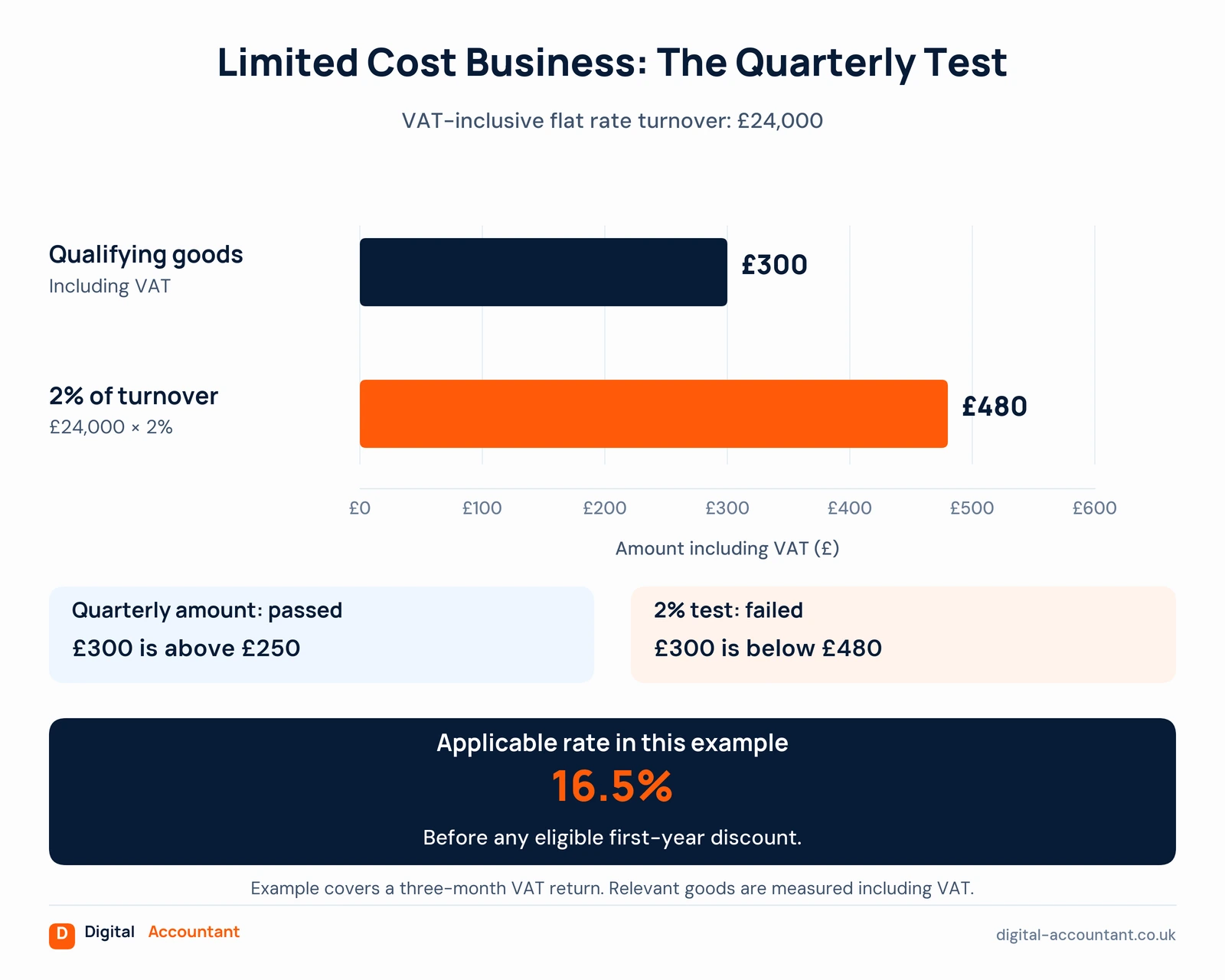
The rate applies when spending on qualifying goods, including VAT, is below 2% of your VAT-inclusive flat rate turnover, or above 2% but below £1,000 a year. The £1,000 limit is adjusted for the return period, so a quarterly return uses £250.
Goods such as normal trading stock, stationery and electricity used exclusively for business can count. Rent, accountancy fees and software subscriptions do not. Capital assets, staff food and most vehicle costs are also excluded.
For example, £300 of qualifying goods against £24,000 quarterly VAT-inclusive turnover exceeds £250 but falls below 2% of turnover, which is £480. You would therefore use 16.5%.
Check each return period, because your spending can change which rate applies.
How the 1% First-Year Discount Changes Your Rate
During your first year of VAT registration, you can normally reduce your rate by one percentage point. That means 14.5% becomes 13.5%, while 16.5% becomes 15.5%.
The discount follows your VAT registration date, not the date you join FRS. If you join six months after registering, you generally have only six months of discount left.
Not sure whether the Flat Rate Scheme would cost you less? Our VAT accountants can compare both methods using your own figures.
Flat Rate VAT vs Standard VAT: Which Costs Less?
Now let’s return to the £10,000 of sales and £2,000 VAT from our earlier example. The table compares what you would pay when recoverable input VAT is either £100 or £400.
It assumes all sales attract 20% VAT and excludes first-year discounts, capital purchases and special adjustments.
| VAT method | £100 reclaimable input VAT | £400 reclaimable input VAT |
|---|---|---|
| Standard VAT accounting | £1,900 | £1,600 |
| FRS at 14.5%, where eligible | £1,740 | £1,740 |
| FRS at 16.5% for a limited cost business | £1,980 | £1,980 |
The flat rate rows represent different classifications, not rates you can choose between. The 14.5% calculation assumes you qualify for that sector rate and are not a limited cost business.
At 14.5%, FRS saves £160 when reclaimable input VAT is £100. But when it reaches £400, standard accounting is £140 cheaper. The break-even point is £260.
At 16.5%, you retain just £20 of the VAT collected. More than £20 of otherwise reclaimable input VAT makes standard accounting cheaper in this example.
For your own comparison, use a representative year and include any changes you expect in your spending. Calculate the position without the first-year discount too, so you know whether any saving is temporary.
How Can You Join or Switch Away From the Flat Rate Scheme?
Once you decide to change methods, you need to contact HMRC and use the correct date in your accounting records.
Apply to HMRC and Confirm When the Scheme Starts
You can apply when registering for VAT. If you are already registered, use HMRC’s online application or form VAT600FRS.
HMRC confirms acceptance and your start date in writing. This is normally the start of the VAT period after it receives your application. Use the confirmed date in your records rather than assuming you can begin immediately.
Notify HMRC When Leaving and Check Any VAT Adjustments
You can leave voluntarily when the scheme no longer suits your business. Write to HMRC with your business details, VAT number and proposed leaving date. HMRC confirms your leaving date in writing. You remain VAT registered unless you deregister separately.
Before switching, check whether a stock adjustment is available and how to handle outstanding invoices. This is particularly important if you used the scheme’s cash-based turnover method, so unpaid sales are neither missed nor accounted for twice.
What are the disadvantages of flat rate VAT?
The Flat Rate Scheme can simplify your VAT calculation, but it is not always the cheaper option. Before choosing it, consider how these drawbacks could affect your business.
- You Normally Cannot Reclaim VAT on Everyday Purchases: Under the scheme, you generally cannot recover VAT on your ordinary business expenses. As your running costs increase, the VAT you give up reclaiming can outweigh any saving from your flat rate. This means standard VAT accounting could become more cost-effective even if your sales stay the same.
- Not Every Large Purchase Qualifies for VAT Recovery: There is an exception for a qualifying single purchase of capital expenditure goods costing £2,000 or more including VAT, subject to the recovery rules. However, this does not apply to every expensive purchase. A large invoice for services does not qualify simply because the total exceeds £2,000.
- You May Pay VAT on Sales Where You Charged None: Exempt and zero-rated business sales generally form part of your flat rate turnover. You can therefore owe flat rate VAT on income where you did not charge your customer any VAT. If these sales make up a significant part of your income, include them carefully when comparing the two methods.
- You Still Need to Keep Records and Meet VAT Requirements: A simpler calculation does not remove your bookkeeping responsibilities. You still need records supporting your sales, purchases and the flat rate you use. Unless exempt, you must also meet Making Tax Digital requirements, including keeping digital records and using compatible software.
For a comparison based on your own records, speak to our online VAT accountants. We can check your eligibility, calculate both VAT outcomes and explain whether joining, staying on or leaving the scheme makes sense for your business.
Get a more accurate idea of what you could pay for your business.
Frequently Asked Questions
Is the flat rate VAT scheme worth it?
It can be worth it if your business has relatively low expenses with reclaimable VAT and your flat rate results in a lower payment than standard VAT accounting. The best way to decide is to compare both methods using your actual sales and costs.
What is the flat rate VAT threshold in 2026?
In 2026, you can join the Flat Rate Scheme if your expected VAT-taxable turnover is £150,000 or less, excluding VAT, over the next 12 months. Once you are in the scheme, you normally have to leave if your turnover exceeds £230,000 including VAT at the relevant review point.
How much VAT do I pay on flat rate?
The amount depends on the flat rate percentage for your business category, with sector rates generally ranging from 4% to 14.5%. Limited cost businesses use 16.5%, and eligible businesses can receive a one percentage point reduction during their first year of VAT registration. Your applicable percentage is applied to your VAT-inclusive flat rate turnover.
Can I reclaim VAT on my business purchases under FRS?
Generally, no. The flat rate percentage is set lower to compensate for the inability to reclaim standard input VAT. The main exception is for single capital assets costing £2,000 or more (including VAT), where you can reclaim the VAT.

Rita writes practical accounting and tax guidance for business owners, drawing on her experience supporting businesses with accounts, tax and financial management.

Bilal reviews our accounting and tax content to ensure it is clear, accurate and aligned with current requirements.