How to Pay Yourself From a Limited Company in the UK: 2026/27 Guide
You can pay yourself from a limited company through a salary, dividends or a combination of both. You can also claim back business expenses you paid personally or recover money you previously lent to the company. But how should you pay yourself to keep more of what you earn and avoid paying more tax than necessary?


- Published on:
- 27 October 2026
- Last updated on:
- 30 October 2026
Table of contents
The company’s money is separate from your own, so you need to record each payment correctly, including any money you take as a director’s loan.
Many company owners who are also directors take a salary through PAYE and dividends from profits available for distribution.
The most tax-efficient combination depends on your company’s profits, your other income and whether the company qualifies for Employment Allowance.
Can You Just Transfer Money From Your Limited Company to Yourself?
Yes, but you need to record what the transfer is for. The money belongs to your company, so moving it into your personal account does not automatically make it your pay.
The payment could be:
- Salary
- Dividend
- Repayment of business expenses you paid personally
- or money you previously lent the company.
If it does not fall into one of these categories, it may need to be recorded as a director’s loan, which can have tax consequences.
Before you transfer the money, check how it should be paid and what records you need. This saves you from having to explain months of personal withdrawals when your online accountant prepares the accounts.
Pay Yourself a Salary Through PAYE
You can take a regular salary from your limited company, even if you are its only director and employee. To do this, you need to run the salary through payroll, with any Income Tax and National Insurance calculated through PAYE.
Your salary and any employer National Insurance can usually be deducted from the company’s profits, provided they meet the rules for allowable business expenses. This can reduce the Corporation Tax your company pays.
How Much Salary Should You Pay Yourself in 2026/27?
There is no single salary that works best for every company director. For the tax year from 6 April 2026 to 5 April 2027, these three amounts help explain how your salary affects tax and National Insurance.
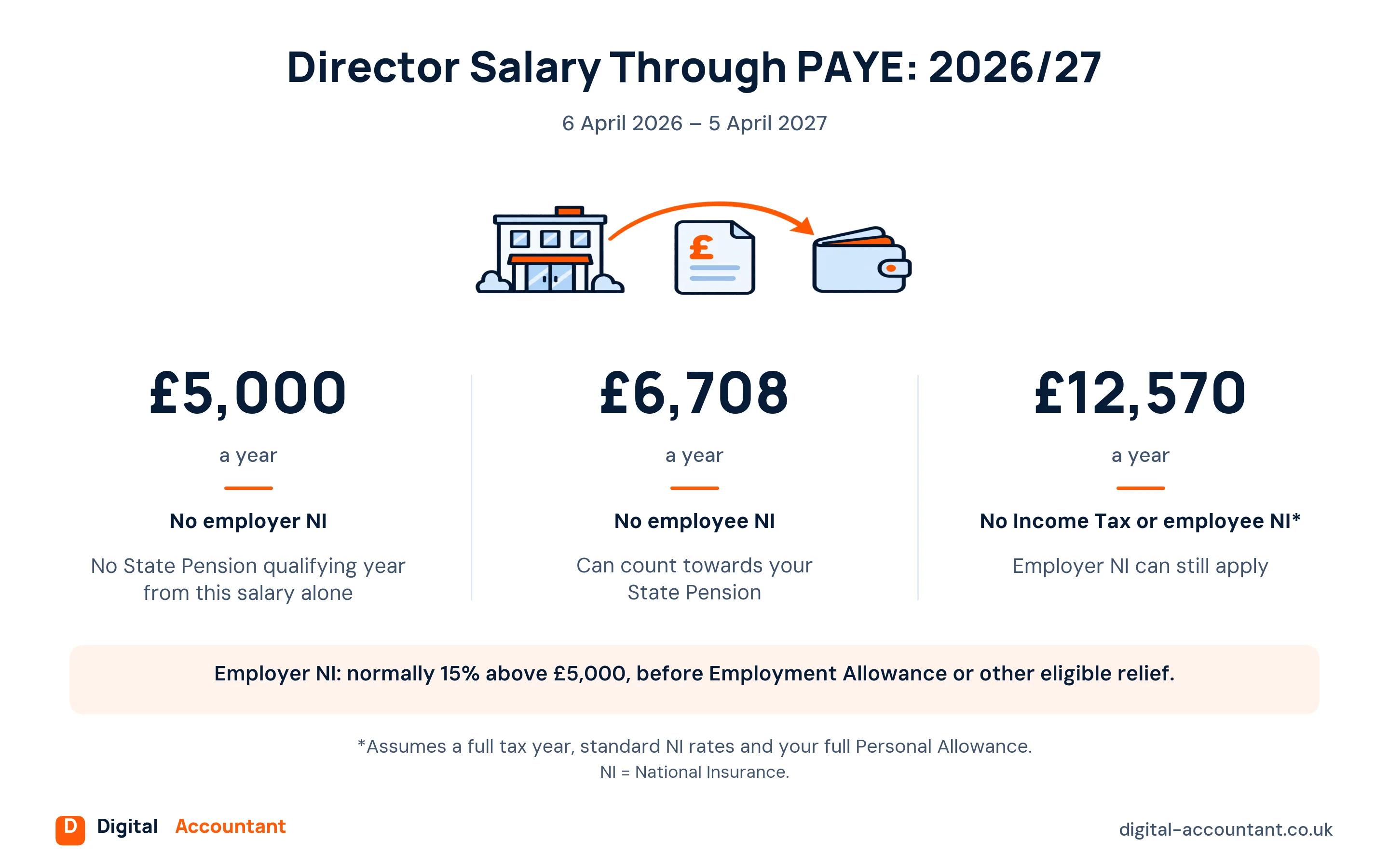
£5,000 a year
Your company normally pays no employer National Insurance on a salary of £5,000. However, this amount is below the Lower Earnings Limit, so the salary alone will not give you a qualifying year towards your State Pension.
£6,708 a year
A salary of £6,708 reaches the annual Lower Earnings Limit for 2026/27 and can count towards your State Pension without you paying employee National Insurance. Your company pays employer National Insurance on the amount above £5,000, unless Employment Allowance or another relief covers the cost.
£12,570 a year
If you have your full Personal Allowance available, you would normally pay no Income Tax or employee National Insurance on this salary. Your company may, however, have to pay employer National Insurance at 15% on the amount above £5,000.
How to Set Up and Pay Your Salary
Before your first payday, check whether you need to register your company as an employer with HMRC. Registration is normally required even when you are the only director and employee.
Once your payroll is set up, you or your accountant can calculate your salary, deduct any tax and National Insurance, and prepare your payslip. The payroll software must send a Full Payment Submission (FPS) to HMRC on or before payday, showing your pay and deductions.
You can then transfer your take-home pay to your personal bank account. Your company must pay any Income Tax and National Insurance due to HMRC by the relevant deadline.
Pay Yourself Dividends From Company Profits
If you own shares in your limited company, you can take dividends alongside your salary. Important: Dividends come from the company’s profits after Corporation Tax. They are not a business expense, so they do not reduce its Corporation Tax bill.
Check How Much Profit Is Available for Dividends
Before you pay yourself a dividend, check your accounts to see how much profit is available. This includes profits retained from previous years, after allowing for accumulated losses, Corporation Tax and dividends already paid.
A healthy bank balance does not tell you how much you can take. Some of that money could be needed for tax, unpaid bills or other commitments. Your accounts need to support the dividend amount, and you also need enough cash left to cover the company’s payments.
How to Declare and Pay Yourself a Dividend
You need to formally declare the dividend and keep minutes of the decision, even if you are the only director. For each payment, prepare a dividend voucher showing the date, company name, shareholder’s name and amount paid. Keep a copy for the company’s records and give one to each shareholder receiving the dividend.
Once you have checked the available profits and completed the paperwork, you can transfer the money to your personal account. You do not have to wait until the end of the financial year. You can take interim dividends during the year when the company has enough profits available.
How Much Tax Will You Pay on Dividends?
For 2026/27, you have a £500 Dividend Allowance, which means the first £500 of your dividend income is tax-free. Any dividends covered by your unused Personal Allowance are also free of Income Tax.
The following rates apply to dividends above those allowances:
| Income Tax band | Dividend tax rate 2026/2027 |
|---|---|
| Basic rate | 10.75% |
| Higher rate | 35.75% |
| Additional rate | 39.35% |
You can estimate the tax on your dividends using our dividend tax calculator, which takes your salary and other income into account.
What Is the Most Tax-Efficient Way to Pay Yourself From a Limited Company?
You can often keep more of your company’s income by taking a combination of salary and dividends. Your salary can reduce the company’s taxable profits, while dividends do not attract National Insurance. However, the company pays Corporation Tax on its profits before you can take them as dividends.
To choose the right balance, look at what you and your company will pay in total. A salary that avoids National Insurance is not always the option that leaves you with the most money.
Choosing the Right Salary and Dividend Mix
First, check whether you have your full Personal Allowance available and whether your company qualifies for Employment Allowance. Then compare different salary amounts, including the company’s Corporation Tax and National Insurance costs and the tax you would pay on dividends.
Here is how one combination could look in practice. Suppose your company has £50,000 in profit before your salary and employer National Insurance. You take a £12,570 salary and receive the remaining profits as dividends.
For this 2026/27 example, you are the only director and shareholder, have no other income and have your full Personal Allowance available. You are a director for the full tax year, and your company cannot claim Employment Allowance. The company has a 12-month accounting period, no associated companies, no previous losses and no dividends already paid.
| Calculation | Amount |
|---|---|
| Company profit before your salary and employer National Insurance | £50,000.00 |
| Your salary | £12,570.00 |
| Employer National Insurance: 15% of the salary above £5,000 | £1,135.50 |
| Company profit after deducting these costs | £36,294.50 |
| Corporation Tax at 19% | £6,895.96 |
| Remaining profit available for dividends | £29,398.54 |
| Your dividend tax after the £500 Dividend Allowance | £3,106.59 |
| Your total take-home income after all taxes due (£50,000-£1,135.50-£6,895.96-£3,106.59) | £38,861.95 |
You pay no Income Tax or employee National Insurance on your salary in this example. Your dividends stay within the basic-rate band, so you pay 10.75% on the amount above the £500 Dividend Allowance.
After dividend tax, you receive £26,291.95 in dividends alongside your £12,570 salary. This assumes the company has enough cash to pay the dividends and meet its other commitments.
If you are unsure which salary and dividend combination would leave you better off, you can ask an accountant to review your company’s profits and your other income.
If You Are the Only Director and Employee
If you are the company’s only director and employee, you cannot claim Employment Allowance against employer National Insurance on your salary. Under the standard rules for 2026/27, your company pays 15% on your annual salary above £5,000.
You might be tempted to stop at £5,000 to avoid that charge. Before you do, check how much Corporation Tax a higher salary would save and whether your salary will count towards your National Insurance record. You could keep more overall despite the employer National Insurance cost.
If Your Company Has Other Employees
If another employee also earns above the employer National Insurance threshold, your company could qualify for Employment Allowance. It still needs to meet the other eligibility rules, but the single-director restriction would no longer prevent a claim.
The allowance can reduce your company’s employer National Insurance bill by up to £10,500 in 2026/27. Check how much is used by your employees’ wages before assuming it will cover the contributions on your salary.
If enough allowance remains, your company can cover those contributions too. This can make a higher salary more tax-efficient, so include the available allowance when comparing your options.
If You Have Income From Somewhere Else
If you also receive income from another job, property, a pension or investments, include it before deciding how much salary to take. Your other income can use your Personal Allowance and affect the rate of tax you pay on dividends.
For example, you will not receive a £12,570 company salary tax-free if another job has already used your full Personal Allowance. Your dividends could also fall into a higher tax band.
How Much Money Should You Leave in Your Company Before Paying Yourself?
There is no fixed amount that every company should keep. You need to leave enough to cover tax bills, day-to-day running costs and upcoming payments, even if you have not received the bills yet.
Before deciding how much to take, set aside money for:
- Tax liabilities: Corporation Tax, PAYE, National Insurance and VAT where applicable.
- Business expenses: Supplier invoices, employee wages, rent, software subscriptions and loan repayments.
- A cash reserve: Enough to keep the business running if customers pay late, income falls or an unexpected expense comes up.
Common Mistakes To Avoid When Paying Yourself From a Limited Company
Most problems are not caused by making the bank transfer itself. They happen when directors take money without first establishing what the payment is and whether the company can legally make it.
Taking Dividends When the Company Does Not Have Enough Profit
You cannot pay yourself a dividend just because there is money in the company account. Check that the company has enough profits available after accounting for Corporation Tax, previous losses and dividends already paid. If you take more than the available profits, you could have to repay the excess to the company.
Making Personal Transfers Without Recording What They Are
If you regularly transfer money to your personal account without recording it, you can lose track of how much you have taken and what each payment was for.
Record each transfer as salary, a dividend, reimbursement of business expenses or repayment of money you lent the company.
If you take money outside these categories, it may need to be recorded as a director’s loan.
Taking Too Much Out and Leaving the Company Short for Tax
You could take a dividend from available profits and later find there is not enough cash to pay the company’s tax bill.
Before deciding how much to take, calculate what the business needs for tax, supplier invoices, wages and upcoming expenses. Keep enough money in the company to cover these payments.
What If the Company Owes You Money?
If you have paid company expenses yourself or lent money to the business, the company can pay you back. You need to record these repayments separately from salary and dividends so your accounts show why you received the money.
Reclaim Expenses You Paid Personally
If you pay for a business expense from your personal account, you can claim the cost back from your company. The reimbursement is normally tax-free when the expense meets HMRC’s rules for business expenses.
Keep the receipt and record what you bought, how much you paid and why it was needed for the business. This helps show that the payment covers a company expense rather than a personal purchase.
Repay Money You Previously Lent the Company
If you lent personal money to your company, you can take it back when the business has enough cash to repay you. Repayment of the original loan is not salary or a dividend and does not normally create a personal tax bill.
Keep your director’s loan account up to date so it shows how much the company still owes you.
Frequently Asked Questions
Can I just take money from my Ltd company?
You can, but each withdrawal needs to be recorded as salary, a dividend, repayment of expenses or money you lent the company, or a director’s loan. The money in the company account is separate from your personal money.
Do I Have to Pay Myself a Salary as a Limited Company Director?
No, being a director does not automatically mean you must take a salary. If you also work under an employment contract, minimum wage rules can apply.
Will Paying Myself a Low Salary Affect My State Pension?
It can if your salary is below the Lower Earnings Limit and you do not qualify through other earnings, National Insurance credits or voluntary contributions. Dividends do not count towards your State Pension.
Can My Limited Company Pay Into My Pension?
Yes, your company can make employer contributions directly into your pension. These can reduce its Corporation Tax bill when they meet the business expense rules, but you also need to check your pension annual allowance.
Can I Borrow Money From My Limited Company?
Yes, through a director’s loan, which you must record and repay. Tax charges can arise depending on the loan amount, interest charged and repayment date.
Should I Review My Salary and Dividends Every Tax Year?
Yes, because tax rates, thresholds, company profits and your other income can change. A yearly review helps you check whether your salary and dividend combination is still tax-efficient.

Rita writes practical accounting and tax guidance for business owners, drawing on her experience supporting businesses with accounts, tax and financial management.

Bilal reviews our accounting and tax content to ensure it is clear, accurate and aligned with current requirements.