Input VAT vs Output VAT: How They Affect Your VAT Return
Input VAT is the VAT charged on your business purchases, while output VAT is the VAT you charge on taxable sales.


- Published on:
- 16 October 2026
Table of contents
Under standard VAT accounting, you subtract the input VAT you can reclaim from your output VAT. The difference determines whether you need to pay HMRC or are due a VAT refund.
However, VAT charged on a business expense is not always reclaimable in full. Some costs have restrictions, so you need to check how much you are entitled to recover before deducting it on your VAT return.
What Is Input VAT and What Does It Cover?
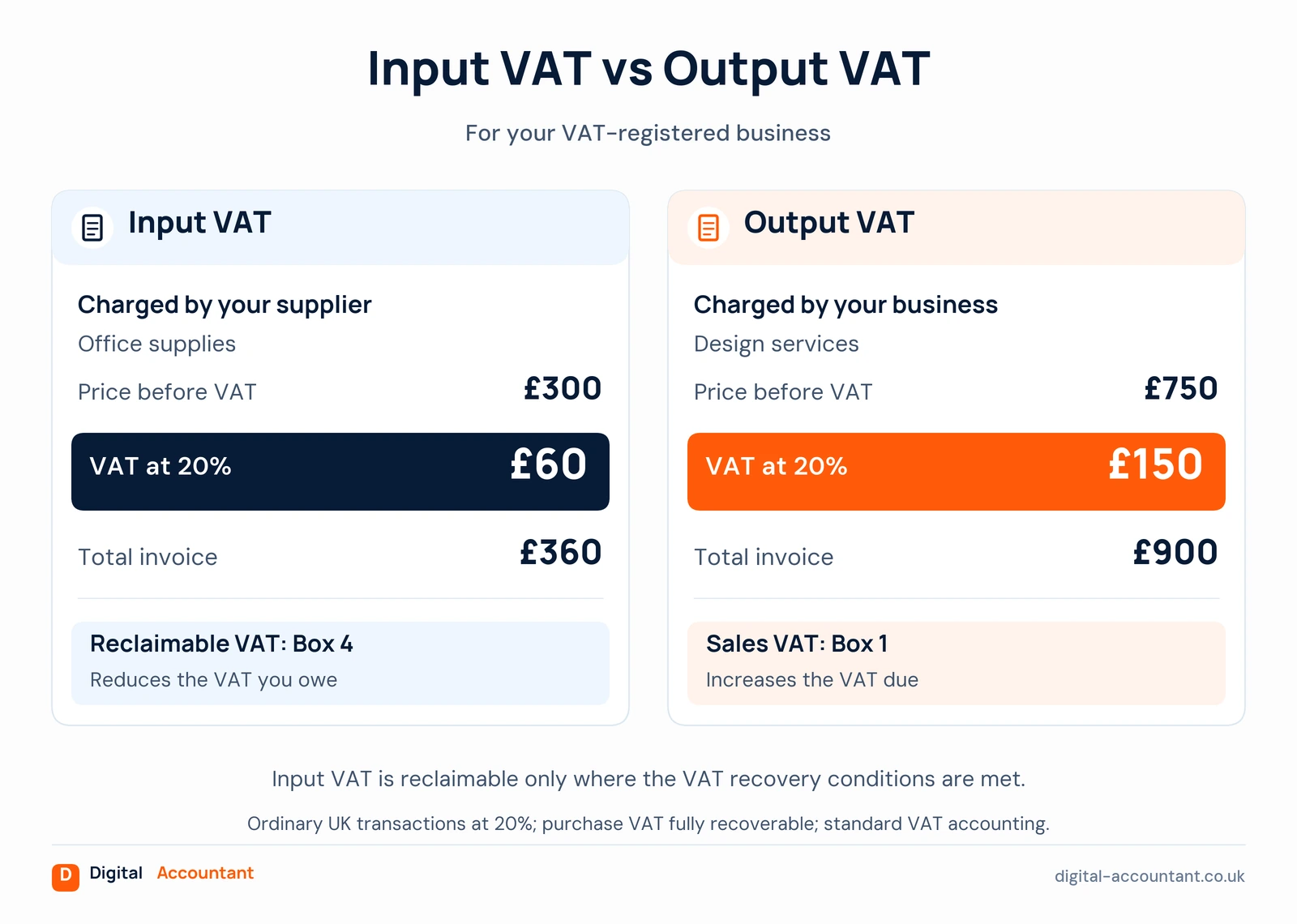
Input VAT, also known as input tax, is the VAT charged on goods and services you buy for your business. It can include everyday running costs, stock and larger purchases such as equipment or machinery. VAT on imported goods can also count as input VAT.
Examples of Input VAT on Business Costs
Common business purchases that may include VAT are:
- Stock, raw materials and packaging.
- Computers, office equipment and software.
- Accountancy, legal and advertising services.
- Business utility bills where VAT applies.
Not every business expense includes VAT, so check your supplier’s invoice rather than assuming there is an amount to reclaim. Employee wages do not carry VAT, and suppliers who are not VAT registered cannot charge it.
When Can Your Business Reclaim Input VAT?
Your business generally needs to be VAT registered, and the purchase must relate to taxable business activities. These include sales at the standard rate of 20%, the reduced rate of 5% and the zero rate of 0%. You can therefore reclaim eligible purchase VAT even when your own sales are zero-rated.
You normally need a valid VAT invoice to support your claim. For imported goods, keep the relevant import VAT documents.
If a purchase is used for both business and personal purposes, you can usually reclaim only the eligible business proportion. For example, if an invoice includes £60 VAT and the purchase is used 60% for business, the claim would be £36, provided no other recovery restriction applies.
Some purchases made before VAT registration can also qualify:
- Goods bought within the previous four years: You must generally still have the goods when you register, or have used them to make other goods you still hold.
- Services bought within the previous six months: These may qualify if they relate to the business now registered for VAT.
Both categories remain subject to the relevant business-use and VAT recovery conditions.
Which Costs Have Restricted VAT Recovery?
A business purpose alone does not guarantee that you can reclaim VAT. Particular restrictions apply to:
- Entertaining UK clients: VAT on client entertainment is usually blocked, even when the expense relates to your business.
- Buying cars available for private use: VAT on the purchase is usually blocked, unless a specific exception applies.
- Costs relating to exempt sales: VAT on these costs is normally not recoverable. If your business makes both taxable and exempt sales, partial exemption rules determine your claim. Small amounts of VAT relating to exempt sales may be recoverable under the de minimis rules.
The Flat Rate Scheme also restricts recovery of most purchase VAT. An exception may apply to a single purchase of qualifying capital expenditure goods costing £2,000 or more, including VAT. Services do not qualify for this exception.
What Is Output VAT and When Is It Charged?
Output VAT, also known as output tax, is the VAT your business charges customers on taxable sales when you are VAT registered. You calculate it using the selling price before VAT and the rate that applies to the goods or services you supply.
VAT Rates for Taxable Sales in the UK
The UK has three main VAT rates:
- 20% standard rate: Applies to most goods and services.
- 5% reduced rate: Applies to certain goods and services, including domestic energy and children’s car seats.
- 0% zero rate: Applies to qualifying goods and services, including most food and children’s clothes.
Zero-rated sales remain taxable, even though no VAT is added to the customer’s bill. You can still reclaim eligible VAT on related business costs. Exempt sales, however, can restrict how much VAT you recover on purchases.
An Example of Output VAT on a Sales Invoice
Suppose your VAT-registered design business charges a UK client £750 before VAT for standard-rated services. The invoice would show:
- Design fee: £750.
- VAT at 20%: £150.
- Total invoice: £900.
Your sales income is £750. You report the £150 as output VAT on your VAT return.
The VAT invoice must show the VAT separately and include the other required details, such as your VAT registration number.
Input VAT vs Output VAT: What’s the Difference
Input VAT relates to your business purchases, while output VAT relates to your taxable sales. The table shows how each is treated under standard VAT accounting.
| Point of comparison | Input VAT | Output VAT |
|---|---|---|
| Transaction | Business purchases, expenses and imports | Taxable sales and other transactions on which VAT is due |
| Alternative name | Input tax | Output tax |
| Who normally charges it? | Your supplier | Your business |
| Supporting records | Supplier VAT invoices and relevant import VAT documents | Sales VAT invoices and other sales records |
| Example at 20% | £60 VAT on a purchase costing £300 before VAT | £150 VAT on a sale worth £750 before VAT |
| Effect on your VAT balance | Reduces the amount payable where the VAT is reclaimable | Increases the VAT due before deductions |
| Usual VAT return box | Reclaimable VAT goes in Box 4 | VAT due on sales goes in Box 1 |
| Accounting entry | Recoverable VAT is debited to the VAT control account | Output VAT is credited to the VAT control account |
| Treatment in profit figures | Recoverable VAT is recorded separately from the purchase cost | VAT charged is recorded separately from sales income |
Who Pays Input VAT and Who Charges Output VAT?
In the design invoice example, the £150 you charge is output VAT for your business. If your customer is a VAT-registered business buying the service for business use, the same £150 is its input VAT. Whether it can reclaim that amount depends on the VAT recovery rules.
For an ordinary standard-rated UK sale, you charge VAT whether your customer is a VAT-registered business or an individual. A customer who cannot reclaim the VAT bears it as part of the cost.
How Does Each Affect Your VAT Bill?
Output VAT increases your VAT liability, while eligible input VAT reduces it. The balance determines whether you need to pay HMRC or are due a refund.
If you claim purchase VAT that you are not entitled to recover, your return can show less VAT payable than you actually owe. If you miss an eligible claim, you could pay more than necessary or receive a smaller refund.
When we review your VAT return, we check the VAT recorded on sales and confirm which purchase VAT is recoverable before calculating the final balance.
How to Calculate Input VAT
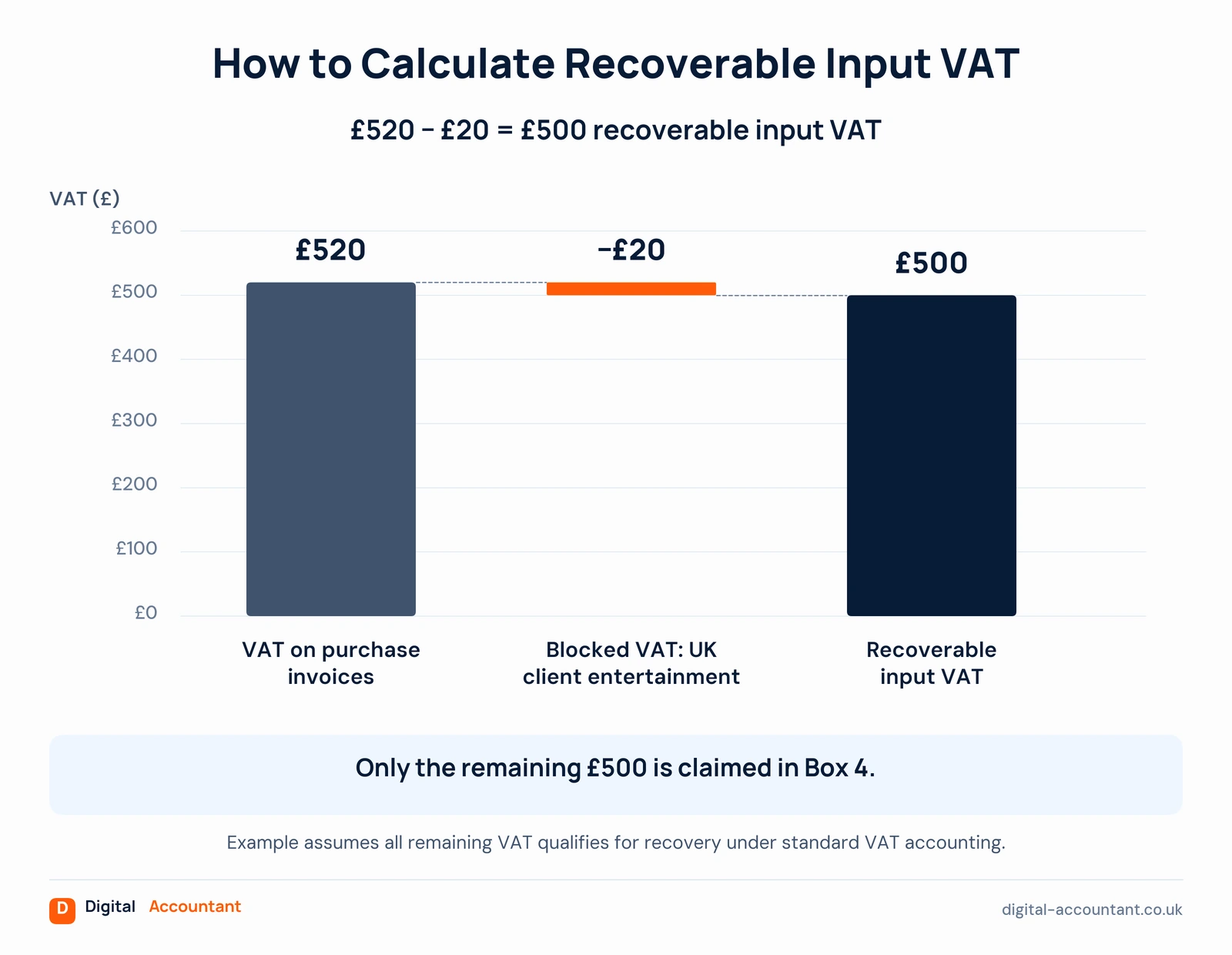
Under standard VAT accounting, start with the VAT correctly charged on valid purchase invoices for the relevant VAT period. Deduct VAT on supplier credit notes and exclude amounts you cannot reclaim, including any personal-use proportion.
For example, suppose your invoices show £520 VAT, including £20 on UK client entertainment that is not recoverable. If the remaining VAT qualifies for recovery, your claim is:
£520 − £20 = £500 recoverable input VAT
Applying 20% to your total business spending would give the wrong result. Some costs have no VAT, while others carry a different rate. Your calculation must reflect the VAT actually charged and how much you are entitled to reclaim.
How to Calculate Output VAT
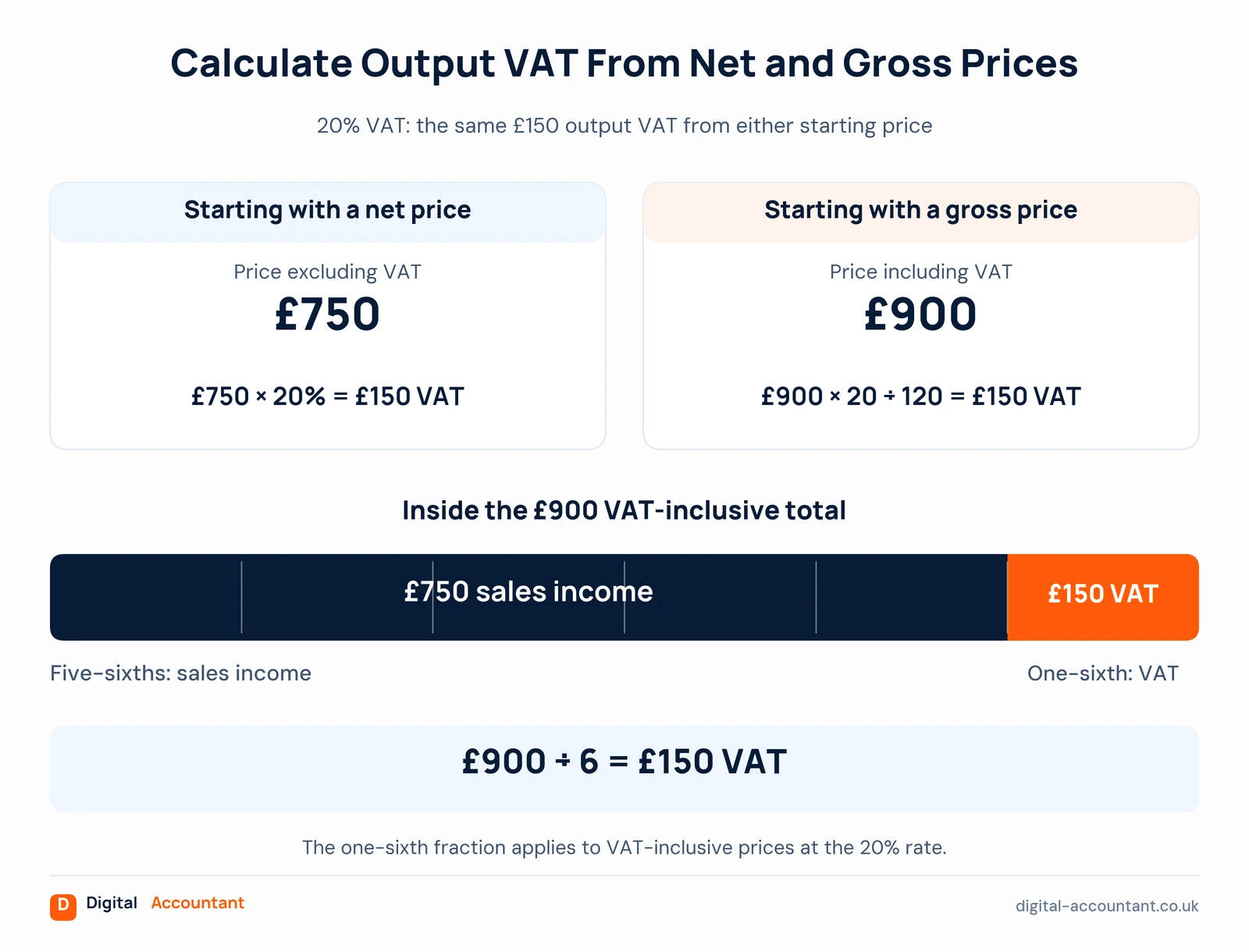
If your selling price excludes VAT, multiply it by the rate that applies to the sale. For the £750 design fee charged at the standard rate:
£750 × 20% = £150 output VAT
If the agreed price already includes VAT, you need to extract the VAT from that total. At 20%, the VAT fraction is 20 ÷ 120, or one-sixth. For a £900 VAT-inclusive invoice:
£900 × 20 ÷ 120 = £150 output VAT
The total therefore consists of £750 sales income and £150 VAT. Applying 20% directly to the £900 would give £180, overstating the VAT by £30.
To calculate output VAT for your return, add up the VAT due on sales and any other relevant outputs for the period, then deduct VAT on sales credit notes.
How to Calculate Your VAT Payment or Refund
Deduct the input VAT you can reclaim from your output VAT to calculate your VAT payment or refund:
Output VAT − recoverable input VAT = VAT payable or refundable
On your VAT return, Box 5 shows the difference between Box 3, total VAT due, and Box 4, VAT reclaimed. Box 3 combines the VAT in Box 1 with any VAT in Box 2 on goods acquired into Northern Ireland from the EU.
The accounting method also affects which transactions belong on each return. Standard VAT accounting follows the tax point, which determines when VAT must be accounted for.
Under cash accounting, you generally account for sales VAT when customers pay you and reclaim purchase VAT when you pay suppliers. The Flat Rate Scheme uses a different payment calculation.
What Happens When Output VAT Is Higher Than Input VAT?
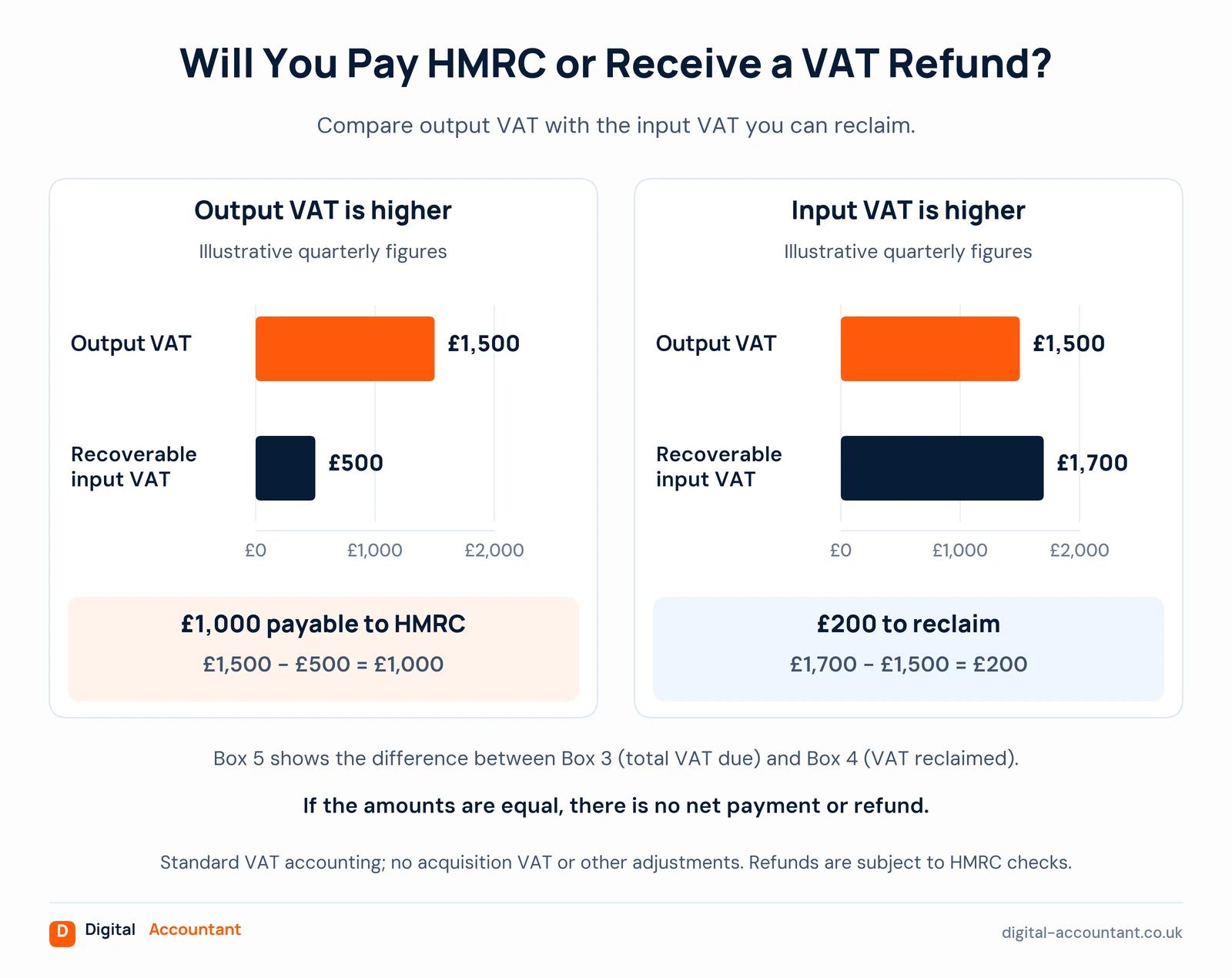
Suppose your design business makes £7,500 of standard-rated sales before VAT during a quarter. This produces £1,500 output VAT. After deducting the £500 recoverable input VAT calculated earlier, your payment is:
£1,500 − £500 = £1,000 payable to HMRC
This example assumes there is no additional acquisition VAT or other adjustment.
What Happens When Input VAT Is Higher Than Output VAT?
In another quarter, equipment purchases could increase your recoverable input VAT to £1,700, while output VAT remains £1,500. Your refund would be:
£1,700 − £1,500 = £200 to reclaim
Your business is now in a repayment position, subject to HMRC’s checks. This can happen after a large equipment purchase or when zero-rated sales generate no output VAT but related business costs include reclaimable VAT.
If output VAT and recoverable input VAT are equal, there is no net amount to pay or reclaim. You must still submit your VAT return.
How Are Input VAT and Output VAT Recorded in Your Accounts?
Your VAT control account tracks the VAT you owe and can reclaim. These amounts stay separate from sales income and business costs.
The £900 design invoice records £750 as sales income. You credit the £150 output VAT to the VAT control account.
Office supplies costing £300 plus £60 VAT create a £300 expense. You debit the £60 VAT to the control account if it is fully recoverable. VAT you cannot reclaim normally forms part of the expense or asset cost.
Box 6 normally shows sales excluding VAT. Box 7 normally shows purchases excluding VAT. The VAT amounts appear separately in the relevant boxes.
Reconcile the account with your VAT returns and HMRC payments or refunds. Include unpaid balances from earlier periods.
Keep invoices and credit notes for at least six years. Making Tax Digital for VAT requires digital VAT records and compatible submission software. These requirements apply unless you are exempt.
Get Help With Your VAT Calculations and Returns
Our VAT accountants can review your sales and purchase records, check which input VAT you can reclaim and prepare your VAT return. If you are unsure about the VAT on an invoice or need help with your next return, get in touch to discuss your business’s requirements.
Frequently Asked Questions
Can you give me an example of input VAT?
If your business buys office supplies for £300 plus VAT at 20%, the supplier charges £60 VAT. That £60 is your input VAT. A VAT-registered business can reclaim it if the purchase qualifies for full VAT recovery.
Is output VAT a debit or credit?
Output VAT is credited to the VAT control account because it represents VAT you owe HMRC. For a £750 sale plus £150 VAT, you credit £150 to that account. The £750 is recorded separately as sales income.
Is input VAT a debit or credit?
Recoverable input VAT is debited to the VAT control account. For a £300 purchase plus £60 fully recoverable VAT, you debit £60 to that account. VAT you cannot reclaim forms part of the expense or asset cost instead.
Can I claim VAT on all purchases?
No, you cannot reclaim VAT on all business purchases, as certain costs, such as UK client entertainment and cars available for private use, are usually restricted. VAT on purchases relating to exempt sales is also generally not recoverable, although partial exemption and de minimis rules may allow some recovery. You also cannot reclaim VAT on costs that do not attract VAT, such as employee salaries, or VAT-exempt purchases, such as insurance, because no VAT is charged on them.
I do not have a receipt - can I claim VAT on the purchase if the supplier is VAT registered?
You can’t reclaim VAT simply because the supplier is VAT registered. HMRC normally requires a valid VAT invoice or other acceptable evidence showing that VAT was charged on the purchase. If you do not have a receipt, you should request a duplicate VAT invoice from the supplier, and you can only reclaim VAT on goods or services where VAT has actually been charged and is recoverable. HMRC may exceptionally accept alternative evidence if a VAT invoice cannot be obtained despite reasonable attempts.

Rita writes practical accounting and tax guidance for business owners, drawing on her experience supporting businesses with accounts, tax and financial management.

Bilal reviews our accounting and tax content to ensure it is clear, accurate and aligned with current requirements.