Pros and Cons of Being VAT Registered for Small Businesses


- Published on:
- 10 October 2026
- Last updated on:
- 13 October 2026
Table of contents
So, you have been thinking about becoming VAT registered but are not sure whether it's going to benefit your business or not. Well, let’s get straight to the point and see the pros and cons of being VAT registered. After that we shall discuss whether it’s worth it for your business to register for VAT or not.
Benefits of Being VAT Registered for Small Businesses
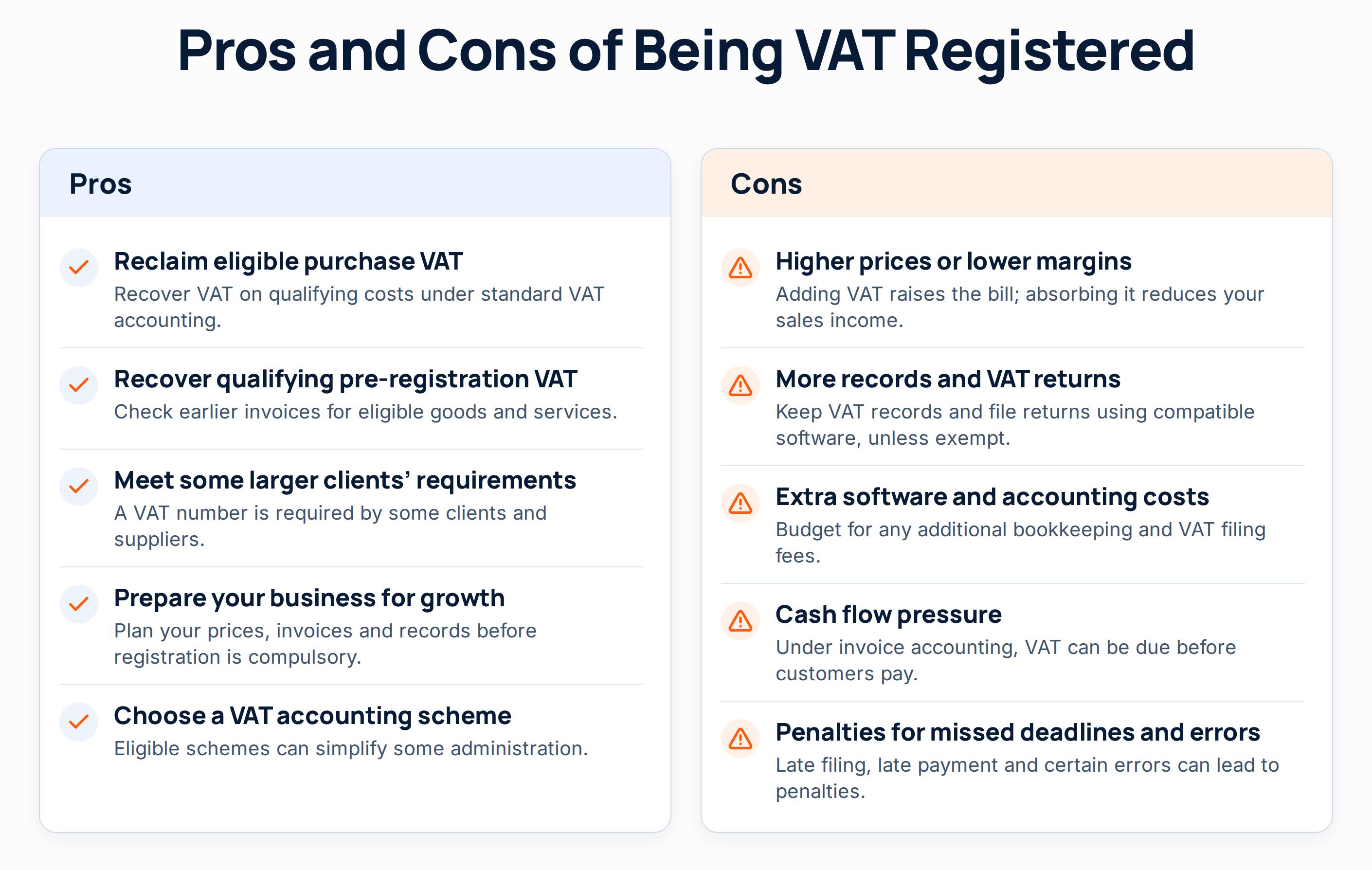
VAT registration can benefit your business in several ways. The main advantages depend on what you spend, who you work with and how your business is growing.
1. Reclaim VAT on Eligible Business Expenses
Under standard VAT accounting, you can reclaim VAT on eligible purchases used for your taxable business activities, including stock, equipment and professional fees. This is input VAT, which you deduct from the output VAT charged on sales.
When recoverable input VAT exceeds output VAT, you can claim the difference back from HMRC.
You need valid VAT invoices. The amount you can reclaim depends on business use and any exempt activities, so do not assume every business expense qualifies.
2. Recover VAT on Qualifying Purchases Made Before Registration
Your first VAT return can include qualifying purchases made before registration. For goods, the limit is four years, provided you still hold them or they were used to make goods you still hold. For services, the limit is six months.
The purchases must relate to the business now registered and its taxable activities. Review earlier invoices for equipment, stock and setup costs so you do not overlook an eligible claim. You do not need to backdate your VAT registration to claim these amounts.
3. Build Credibility With Larger Clients and Suppliers
A VAT number helps you meet the requirements of larger clients or suppliers that only work with VAT-registered businesses.
Before you register for this reason, check whether the organisations you plan to work with have that requirement.
4. Prepare for Growth Beyond the VAT Threshold
If your business is growing and your taxable turnover is getting closer to the VAT threshold (£90,000), registering early can make the transition easier. You can update your pricing, invoices and bookkeeping before registration becomes compulsory.
It also allows you to include VAT in longer-term quotes and contracts from the start.
Before registering early, compare this convenience with the effect VAT could have on your current prices and profits.
5. Use VAT Schemes That Can Simplify Your Accounting
VAT-registered businesses can use certain schemes to make VAT easier to manage. The Annual Accounting Scheme lets eligible businesses submit one VAT return a year and make advance payments towards the bill.
The Flat Rate Scheme works differently. You pay HMRC a fixed percentage of your VAT-inclusive turnover, but you usually cannot reclaim VAT on everyday business purchases.
These schemes can reduce some of the administration, but they do not always reduce the amount of VAT you pay. Compare them with standard VAT accounting before deciding which method suits your business.
The Drawbacks of VAT Registration for Small Businesses
VAT registration also brings extra costs and responsibilities that can affect how you run your business. Here are some of the main drawbacks to consider before you register.
1. Pressure on Customer Prices and Profit Margins
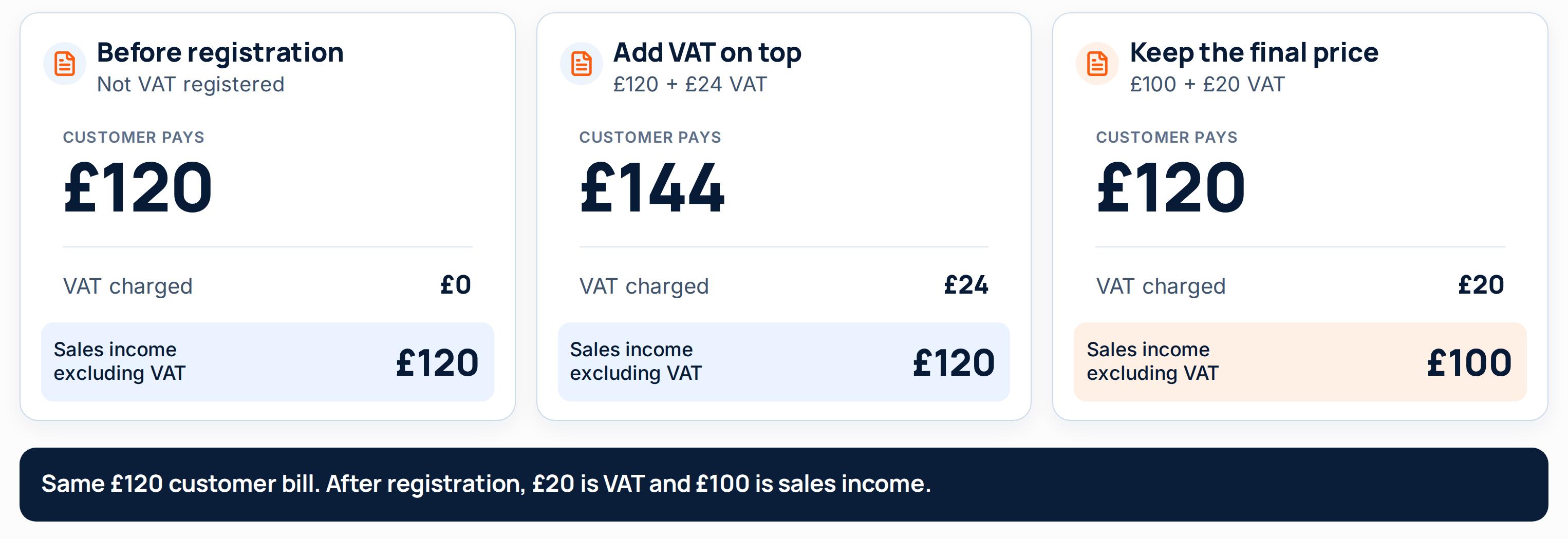
VAT registration can have a direct effect on your prices, especially if you sell to customers who cannot reclaim VAT. If you currently charge £120 for a standard-rated service, adding 20% VAT increases the customer’s bill to £144.
You can keep the final price at £120, but the VAT then comes out of what you already charge. In this case, £20 is VAT and your sales income falls to £100 before expenses. You can recover VAT on eligible business costs, but that does not necessarily make up for the reduction in your margin.
2. More Record Keeping and VAT Return Administration
Once you register for VAT, your bookkeeping needs to be more detailed. You must record the VAT charged on sales, the VAT paid on purchases and keep the supporting records, usually for at least six years.
You also need to follow Making Tax Digital for VAT rules unless you are exempt. This means keeping digital records and using compatible software to submit your VAT returns. Most businesses file returns every quarter, and the usual deadline is one month and seven days after the end of the VAT period.
These responsibilities apply whether you register voluntarily or because your turnover has passed the VAT threshold which is £90,000.
3. Additional Software and Accountancy Fees
VAT registration increases your accounting costs if your current software or accountancy package does not include VAT filing services.
You need compatible software for Making Tax Digital and may also pay more for bookkeeping, VAT checks and return preparation.
Before registering voluntarily, work out the extra cost and compare it with the VAT you expect to recover.
4. How VAT Payments Affect Your Cash Flow
Under standard invoice accounting, you account for VAT when you raise the invoice, even if your customer has not paid you yet. This means your VAT payment can be due before the money reaches your bank account.
The Cash Accounting Scheme works differently. Eligible businesses account for sales VAT when customers pay them, but they also reclaim purchase VAT only after paying their suppliers. Whichever method you use, keep enough money aside to pay HMRC by the deadline.
5. Risk of Penalties for Late or Incorrect VAT Reporting
Once you are VAT registered, you need to submit returns and pay any VAT due by the deadline. Late returns receive penalty points, and quarterly filers face a £200 penalty once they reach four points. Further late returns can lead to additional £200 penalties while you remain at the penalty threshold.
Late VAT payments also lead to interest and can result in separate penalties. HMRC can charge penalties for careless or deliberate errors, so your VAT records and return figures need to be accurate before you submit them.
Not sure whether voluntary VAT registration is worth it for your business? Our VAT accountants can check it against your own figures.
Is It Worth Being VAT Registered for Your Small Business?
VAT registration is worth it when the money you save by reclaiming VAT is greater than the cost registration creates for your business. Your customer type, pricing and VAT-bearing expenses all affect that calculation.
If you are below the compulsory VAT threshold, you have time to compare these factors before registering voluntarily.
When Voluntary VAT Registration Is Worthwhile
Voluntary registration works best when you can add VAT to your existing prices without reducing sales. This is often easier when your customers are VAT registered and can reclaim the VAT you charge.
It also becomes more worthwhile when your business has regular VAT-bearing expenses. The more eligible VAT you recover on purchases, the stronger the financial benefit of registration.
Businesses making zero-rated sales are in a different position. Their sales are charged at 0% VAT, while eligible VAT on business purchases can still be reclaimed. Zero-rated sales are not the same as exempt sales.
When the Costs of VAT Registration Outweigh the Benefits
VAT Registration can reduce your profit when your customers cannot reclaim VAT and you cannot increase your prices. If you keep your final prices unchanged, the VAT comes out of the amount you already charge.
Your expenses also affect the result. High business costs do not always mean high VAT recovery. Wages, for example, do not include VAT.
Compare the Financial Impact Before You Register
Before registering voluntarily, compare what happens if you keep your prices unchanged with what happens if you add VAT on top.
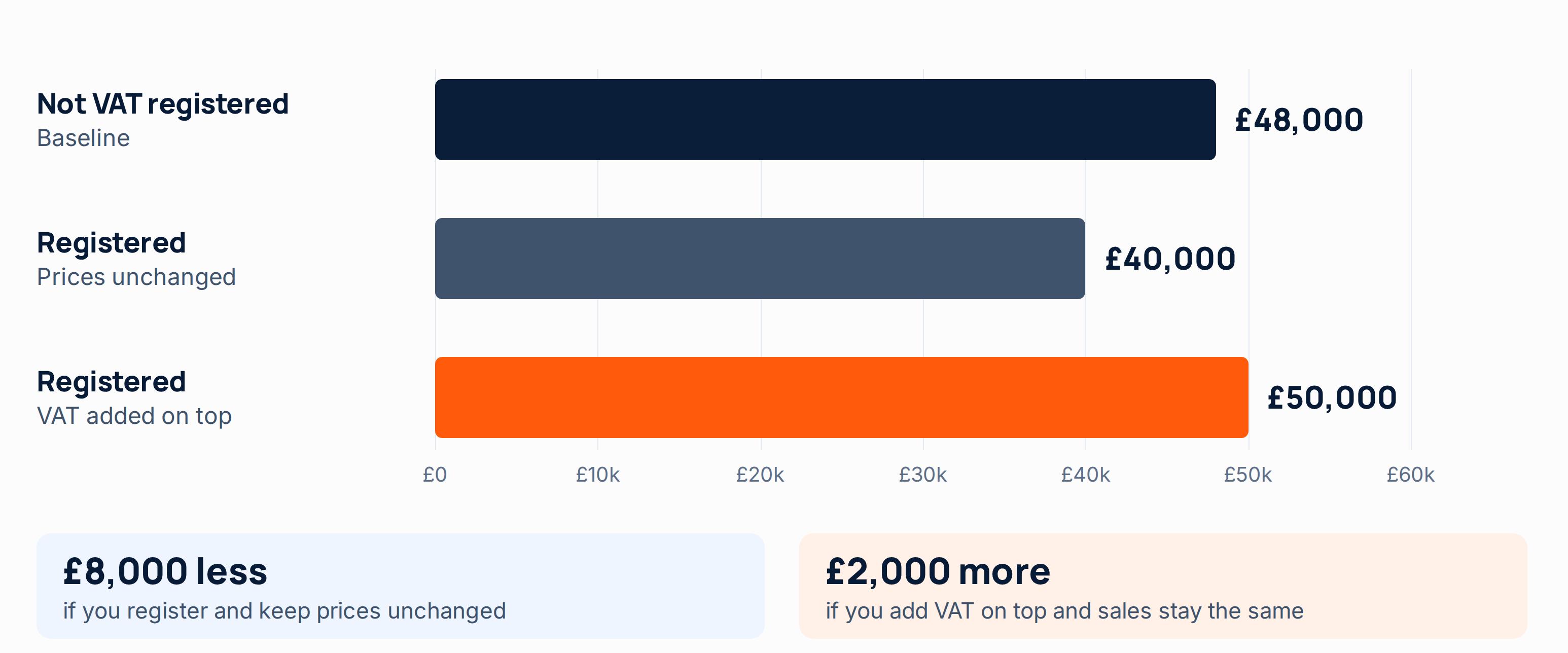
The simple example below assumes annual sales of £60,000 and purchases of £12,000 including VAT of £2,000. All sales and purchases are standard-rated at 20%, and all purchase VAT is recoverable.
| Annual figures | Not registered | Registered: prices unchanged | Registered: VAT added |
|---|---|---|---|
| Customer payments | £60,000 | £60,000 | £72,000 |
| Sales excluding VAT | £60,000 | £50,000 | £60,000 |
| Costs with VAT recoverable amounts | £12,000 | £10,000 | £10,000 |
| Amount left before other costs and taxes | £48,000 | £40,000 | £50,000 |
| VAT liability to HMRC | £0 | £8,000 (£10,000-£2,000) | £10,000 (£12,000-£2,000) |
If prices stay unchanged, the business keeps £8,000 less before other costs and taxes. If VAT is added on top and sales stay at the same level, the business keeps £2,000 more because it recovers VAT on its purchases.
You should also include any extra software, bookkeeping and accountancy costs before deciding whether voluntary registration is financially worthwhile.
Can You register for UK VAT, reclaim VAT on the asset purchase and deregister from VAT in one to two months?
There is no minimum period you must stay registered, so in theory, you could register, reclaim VAT and then deregister within 1-2 months if your circumstances allow.
However, HMRC may scrutinise such cases to ensure the registration and deregistration are genuine and not solely for reclaiming VAT.
If you deregister and still own assets on which you reclaimed VAT, you may need to account for VAT on their value at deregistration if their total value (excluding VAT) is over £5,000.
When Does VAT Registration Become Compulsory?
VAT registration becomes compulsory in the UK once your UK taxable turnover goes over £90,000. This threshold looks at turnover, not profit, so you need to keep an eye on your sales as the business grows.
HMRC applies two main tests:
- Previous 12 months: If your taxable turnover exceeds £90,000 in any rolling 12-month period, you must register within 30 days of the end of the month in which you crossed the threshold.
- Next 30 days: If you expect your taxable turnover to exceed £90,000 in the next 30 days alone, you must register by the end of that period.
For example, if your rolling taxable turnover goes over £90,000 in October, you would normally need to register by 30 November, with your VAT registration taking effect from 1 December.
Zero-rated sales count towards taxable turnover, while exempt and out-of-scope sales do not. Check your rolling turnover regularly rather than waiting until the end of your accounting year.
Speak to Our Accountants About VAT Registration
Before you change prices or apply, speak to our VAT Accountants. Our accountants can review your sales, expenses and customer mix, explain the effect on your margins, and check when registration becomes compulsory.
You can then decide whether to register voluntarily using your own figures, rather than relying on a general list of benefits.
Get a more accurate idea of what you could pay for your business.
Frequently Asked Questions
Is it better to not be VAT registered?
Yes, if your turnover is below the £90,000 threshold, most customers cannot reclaim VAT, and you have little VAT to recover on expenses. Staying unregistered can help you keep prices lower and avoid extra VAT administration.
Is it worth being VAT registered as a limited company?
It can be, but the company structure itself does not decide this. VAT registration is worthwhile when the VAT you reclaim and the way you price your sales outweigh the extra costs and administration.
Can You Cancel Voluntary VAT Registration Later?
Yes. You can ask HMRC to cancel your VAT registration if you are no longer required to be registered and meet the conditions for deregistration.

Rita writes practical accounting and tax guidance for business owners, drawing on her experience supporting businesses with accounts, tax and financial management.

Bilal reviews our accounting and tax content to ensure it is clear, accurate and aligned with current requirements.