VAT Bad Debt Relief: How to Reclaim VAT on Unpaid Invoices
If you have already paid VAT to HMRC but your customer has not paid the invoice, you have covered the VAT yourself.


- Published on:
- 21 October 2026
Table of contents
VAT bad debt relief allows you to reclaim the VAT on the amount your customer still owes. You can claim this relief only if you meet HMRC’s conditions.
What Is VAT Bad Debt Relief?
VAT bad debt relief allows you to reclaim VAT you have already paid to HMRC on eligible unpaid invoices. You claim the relief through your VAT return. This reduces the VAT you owe or increases your VAT refund.
The relief covers only the VAT on the unpaid amount. It does not recover the sales income you have lost. There is no VAT to reclaim on zero-rated or exempt sales because no VAT was charged.
Conditions for Claiming VAT Bad Debt Relief
Here are some of the conditions for claiming VAT bad debt relief.
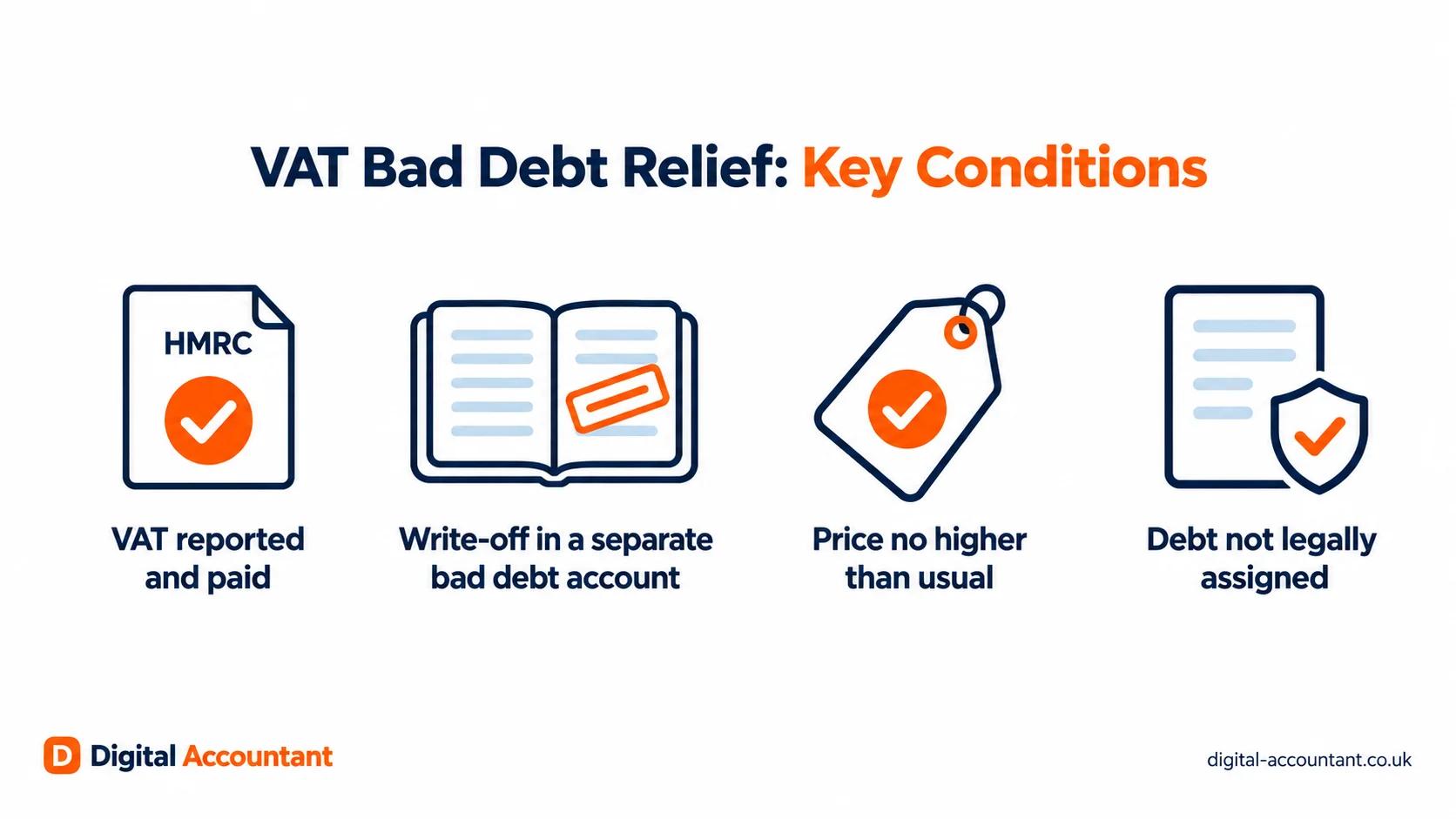
VAT Already Accounted for and Paid to HMRC
You must have reported the VAT on the sale and paid it to HMRC. Your records must show the VAT period in which you reported it. Bad debt relief cannot be used to correct VAT left out of a return.
The Debt Is Written Off in Your VAT Accounts
You must write off the unpaid amount in your day-to-day VAT accounts. You must also transfer that amount to a separate bad debt account.
You cannot issue a credit note simply because your customer has not paid. Credit notes are used to correct genuine invoice errors, overcharges or agreed price reductions.
The Price Does Not Exceed the Normal Selling Price
The amount charged for the goods or services must not exceed their usual selling price. You cannot claim relief on a sale if you have artificially inflated the price to increase the VAT claim.
Restrictions on Sold, Assigned or Factored Debts
You cannot claim relief from vat on bad debts while the debt is legally assigned to another party, such as a factoring company. If the debt is legally transferred back to you, you can claim once you meet the other conditions.
Check your factoring agreement to confirm whether the debt can be reassigned to you before including it in your claim.
When Can You Claim VAT Bad Debt Relief?
You cannot claim VAT bad debt relief simply because an invoice is overdue. You must wait until you are eligible and make your claim before the deadline.
When the Six-Month Waiting Period Starts
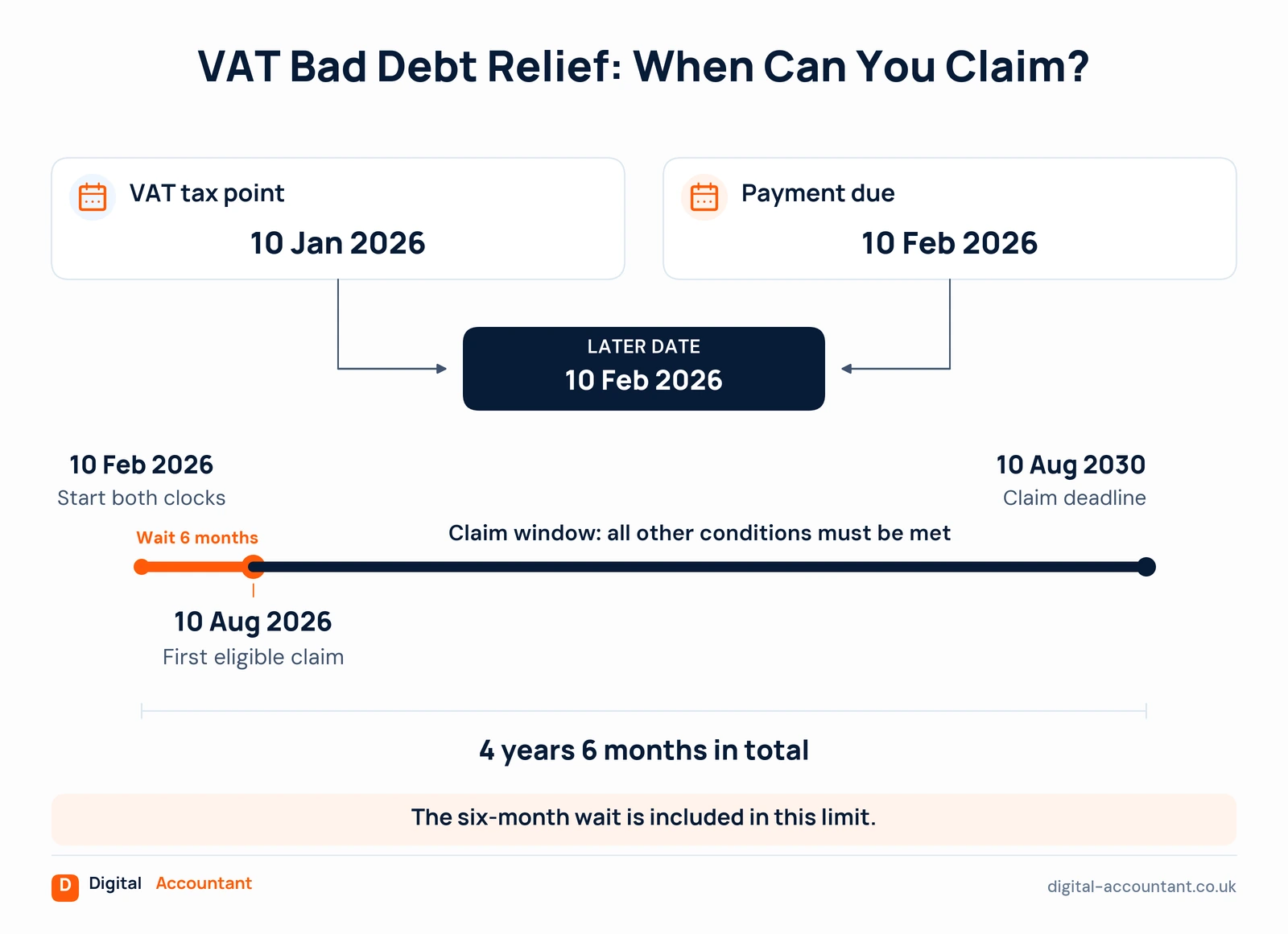
You must wait at least six months from whichever of these dates is later:
- The date payment was due.
- The date of supply, known as the VAT tax point.
For example, the VAT tax point is 10 January 2026, and payment is due on 10 February 2026. The six-month waiting period starts on 10 February. You become eligible to claim on 10 August 2026 if you meet the other conditions.
The invoice date is not automatically the starting date. The six-month wait still applies if your customer becomes bankrupt.
The Four-Year-and-Six-Month Claim Deadline
You must claim within four years and six months of the same date used to start the waiting period. The initial six-month wait is included in this time limit. You do not get another four years and six months after it ends.
Keep a record of the claim deadline for each unpaid invoice so you do not miss the opportunity to reclaim VAT.
How to Calculate the VAT You Can Reclaim
Start with the unpaid balance, including VAT. Use the VAT rate charged on the original sale. Divide the balance by 6 for 20% VAT or 21 for 5% VAT.
A Worked Example for a Fully Unpaid Invoice
You issue an invoice for £1,000 plus £200 VAT, giving a total of £1,200. Your customer pays nothing. If you meet the conditions for relief, you can reclaim:
£1,200 ÷ 6 = £200 VAT reclaimable
The £1,000 sales amount remains unpaid. VAT bad debt relief does not recover that money.
Calculating Relief After a Part Payment
If the customer pays £300 towards the same invoice, the unpaid balance falls to £900:
£1,200 − £300 = £900 unpaid
£900 ÷ 6 = £150 VAT reclaimable
For this calculation, the £300 payment includes £50 of VAT. This leaves £150 of the original £200 VAT available to reclaim.
Allocating Payments Across Multiple Invoices
If a customer does not specify which invoice a payment relates to, allocate it to the earliest supplies first. Follow their allocation to a particular supply only if they identify it and pay for it in full.
For several supplies made on the same day, treat them as one supply for this calculation. Add together their VAT-inclusive values and the VAT charged, then calculate:
Unpaid balance × total VAT charged ÷ total VAT-inclusive value = VAT reclaimable
This calculation accounts for different VAT rates across those supplies. You must also check that you meet the conditions for claiming relief.
When the Customer Pays Everything Except the VAT
Suppose your customer pays the £1,000 net price but leaves £200 outstanding. For bad debt relief, that £200 is still treated as a balance that includes VAT:
£200 ÷ 6 = £33.33 VAT reclaimable
You cannot reclaim the full £200. For this calculation, the £1,000 payment is treated as covering part of the sales amount and part of the VAT.
Not sure how much VAT you can reclaim on an unpaid invoice? Our VAT accountants can check your dates and calculations for you.
How to Make Your VAT Bad Debt Relief Claim
To claim relief from VAT on bad debts, use your aged debtor report to identify qualifying invoices and prepare the adjustment.
Adding the Claim to Box 4 of the Correct VAT Return
Add the eligible VAT to Box 4 of the return covering the date when all claim conditions are met. Leave the original sale and output VAT in the return where they were first reported.
Check that your Making Tax Digital (MTD)-compatible software includes the adjustment in Box 4 before submission.
Claiming Relief After VAT Deregistration
You can claim for eligible debts from supplies made while you were VAT registered, even after cancelling your registration.
Use HMRC's online VAT reclaim service after cancellation, or submit form VAT427 by post. Have your old VAT number, cancellation date, invoices and bad debt details ready.
What Records Do You Need to Support Your Claim?
Your records must link each claim to the original sale and show how you calculated the VAT reclaimed. Keep the following records.
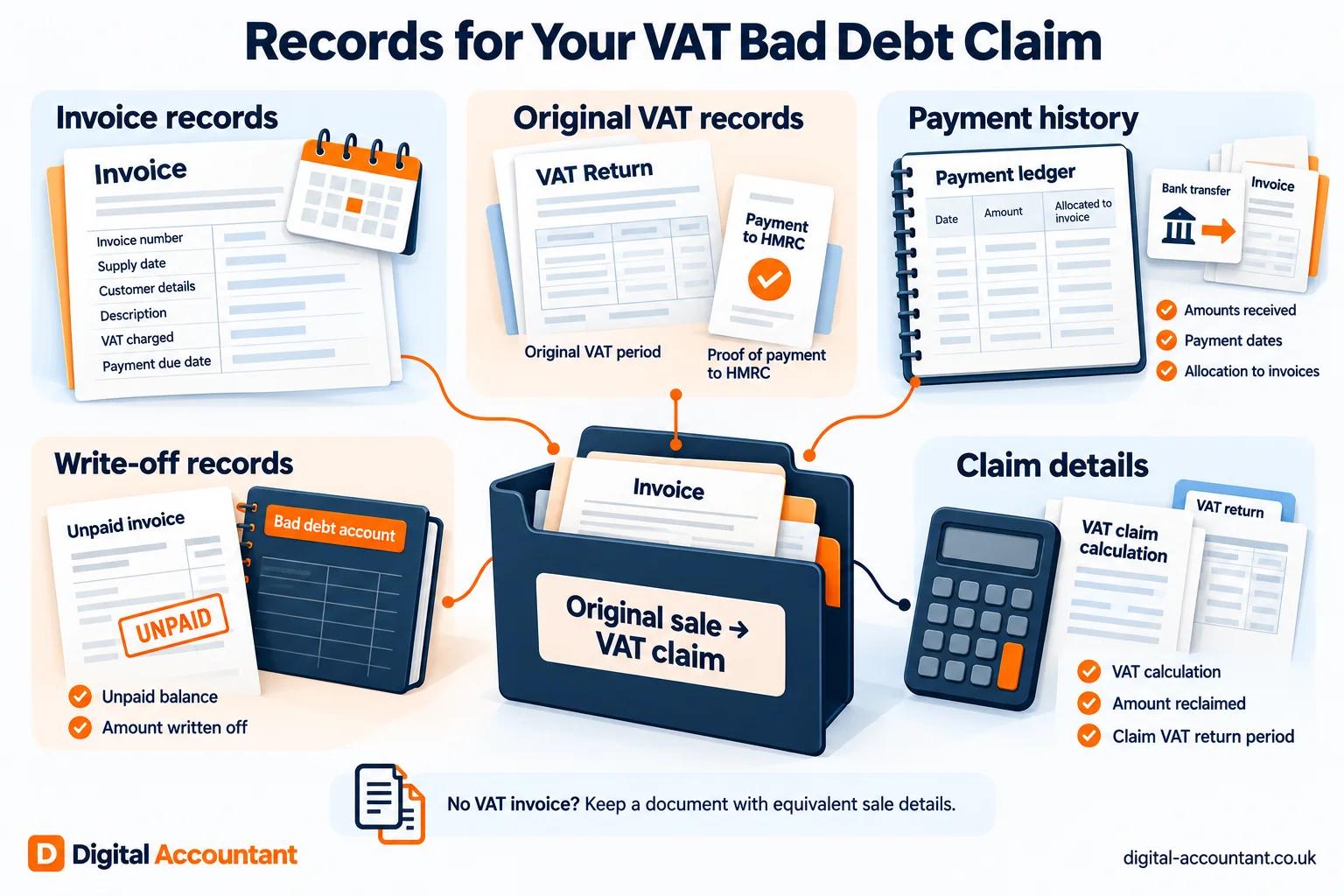
- Invoice records: Keep invoice copies showing the invoice number, supply date, customer details, description and VAT charged. Include evidence of the payment due date.
- Original VAT records: Identify the VAT period in which you originally accounted for the VAT. Keep evidence that you paid it to HMRC.
- Payment history: Record the amounts received, payment dates and how you allocated payments across invoices.
- Write-off records: Record the unpaid balance, the amount written off and the entries in your separate bad debt account.
- Claim details: Keep the VAT calculation, the amount reclaimed and the VAT return period in which you claimed relief.
If you did not issue a VAT invoice, keep another document containing the equivalent details of the sale.
How Long to Keep Your Claim Records
Keep your claim records for at least four years from the date you make the claim. The usual six-year requirement for VAT records also applies. You must keep the documents until both periods have ended.
Do You Need to Notify Your Customer About the Claim?
For current invoices, HMRC does not require you to notify your customer about the claim. The old seven-day notification rule does not apply.
Your customer still owes the unpaid amount after you claim relief. If they reclaimed input VAT on your invoice, they must repay the VAT relating to any balance still unpaid after six months. Count those six months from whichever date is later: the supply date or the payment due date. Your customer must make this adjustment even if you do not claim relief.
What Happens If Your Customer Pays After You Claim?
Your customer can still pay an invoice after you have written it off. If this happens after you claim VAT bad debt relief, you must repay the VAT relating to that payment.
How Much VAT You Must Repay
You reclaimed £200 of VAT on a £1,200 invoice. Let’s say your customer later pays £360, so you must repay:
£200 × £360 ÷ £1,200 = £60 VAT
If the customer pays the invoice in full, you must repay all £200 originally reclaimed.
Reporting the Repayment in Box 1 of Your VAT Return
Add the VAT you must repay to Box 1 of the VAT return for the period in which you receive the payment. Do not amend the return where you originally claimed the relief in Box 4.
How Your VAT Accounting Scheme Affects Bad Debt Relief
The examples above use invoice accounting. Different rules apply if you use the VAT Cash Accounting Scheme or the Flat Rate Scheme.
Unpaid Invoices Under the VAT Cash Accounting Scheme
For sales covered by the VAT Cash Accounting Scheme, you account for VAT when your customer pays. You do not pay VAT on the unpaid amount, so there is no VAT to reclaim through bad debt relief.
Flat Rate Scheme Claims Using Different Turnover Methods
If you use the basic or retailer’s turnover method, calculate relief on eligible standard-rated sales using the 20% VAT fraction. This means dividing the unpaid balance, including VAT, by 6. You do not use your flat rate percentage for this calculation.
The cash-based turnover method allows you to claim a special allowance if:
- Your customer has not paid and at least six months have passed since the date of supply.
- You have not accounted for or paid VAT on that sale.
- You have written off the unpaid amount in your accounts.
To calculate the allowance, subtract the flat rate VAT you would have paid from the VAT charged on the invoice.
For example, a fully unpaid £1,200 invoice includes £200 VAT. If your applicable flat rate is 12%, the calculation is:
£1,200 × 12% = £144
£200 − £144 = £56 relief
Get Help Reclaiming VAT on Unpaid Invoices
We can review your unpaid invoices, check claim dates and calculations, and prepare the VAT adjustment with the supporting records.
Speak to our VAT accountants about your claim. For a question about a particular invoice, use our free Ask an Accountant service.
Get a more accurate idea of what you could pay for your business.
Frequently Asked Questions
Can we claim VAT on bad debts?
Yes. VAT bad debt relief lets you reclaim eligible VAT that you have already accounted for and paid to HMRC on an unpaid invoice. You must write off the debt in your VAT records, transfer it to a separate bad debt account and meet the six-month waiting rule. Once all claim conditions are met, include the eligible VAT in Box 4 of your VAT return.
Can I Reclaim VAT on Bad Debts After Deregistering?
Yes. You can claim for qualifying unpaid invoices relating to supplies made while your business was VAT registered. This includes debts that become eligible for relief after deregistration. Submit the claim through HMRC’s online VAT reclaim service after cancellation, or use form VAT427 by post. Keep your invoices, bad debt records and calculations, as the usual claim conditions and time limits still apply.
Can I Use a Credit Note to Clear an Unpaid Invoice?
No, not simply because your customer has failed to pay. A credit note requires a genuine billing error, overcharge or agreed reduction in the value of the sale. If the invoice is correct and the only issue is non-payment, record the unpaid amount as a bad debt. You can then claim VAT bad debt relief once the invoice meets the qualifying conditions.

Rita writes practical accounting and tax guidance for business owners, drawing on her experience supporting businesses with accounts, tax and financial management.

Bilal reviews our accounting and tax content to ensure it is clear, accurate and aligned with current requirements.