Who Is Exempt From the CIS Scheme? Check If It Applies to You
If you are an employee, the Construction Industry Scheme (CIS) does not apply to your wages. If you are self-employed and a private householder hires and pays you directly for work on their home, those payments are also excluded.


- Published on:
- 30 October 2026
- Last updated on:
- 6 November 2026
Table of contents
There are exclusions for payments made by charities and maintained schools, while other exemptions apply only when specific conditions are met.
To check whether CIS applies to your work, you need to look at who is paying you and what the full contract includes. Your trade alone does not decide the answer. The same type of work can be excluded from CIS on one job and subject to the scheme on another.
When Does CIS Apply to a Payment?
CIS normally applies when a contractor pays a subcontractor under a contract that includes construction work in the UK. This covers building, demolition, site preparation, decorating and certain types of installation and repair work.
The contract can be written or verbal. CIS rules apply whether the subcontractor operates as a sole trader, a partnership or a limited company.
Who Is Excluded From CIS and Which Payments Are Exempt?
CIS exclusions depend on the working arrangement and the people or organisations involved in the payment. Some apply because the worker is an employee or the customer is a private householder. Others depend on the organisation’s legal status or how a property is used.
You need to check the conditions for the payment you are assessing. An exemption for one payment does not automatically cover every business working on the same project.
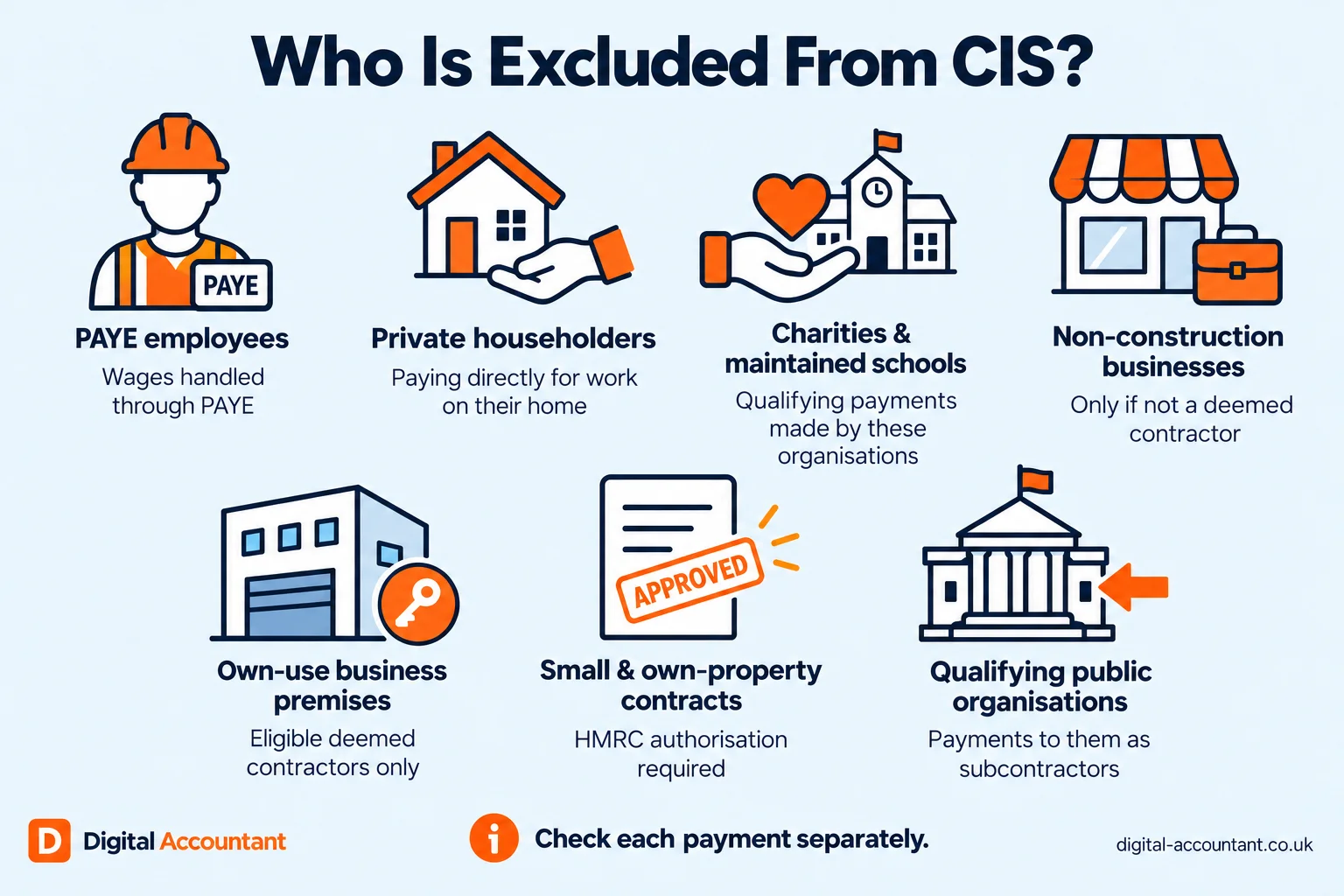
Employees Paid Through PAYE
If you are an employee, your wages are handled under Pay As You Earn (PAYE) rules, even when your job involves construction. CIS deductions do not apply.
The contractor must assess the actual working arrangement for each job. Your CIS registration or previous work as a subcontractor does not prove that you are self-employed.
Work Paid Directly by a Private Householder
If a private householder hires and pays you directly for work on their home, CIS does not apply to that payment. A plumber fitting a homeowner’s bathroom can invoice them without CIS deductions.
If the plumber hires an electrician to help, their payment to the electrician needs a separate CIS assessment. The homeowner’s exclusion does not exempt payments the plumber makes to other subcontractors.
Payments Made by Charities and Maintained Schools
Construction payments made by charities, including trusts established solely for charitable purposes, are excluded from CIS. If the contract is with a charity’s separate trading subsidiary, that exclusion does not extend to the subsidiary.
For maintained schools, the exclusion covers payments made by the governing body or headteacher acting on behalf of the local education authority. Check the legal status of the organisation paying you, as these exclusions do not cover every school or trust.
Non-Construction Businesses That Have Not Become Deemed Contractors
If construction is not part of your business and you have not become a deemed contractor, your construction payments are not subject to CIS.
A non-construction business becomes a deemed contractor when qualifying construction expenditure exceeds £3 million over a rolling 12-month period. It must then apply CIS to payments that are not exempt.
Property developers are mainstream contractors, so this spending threshold does not apply to them. They must assess CIS when paying subcontractors, even on smaller projects.
Own-Use Property Payments by Deemed Contractors
If your business is a deemed contractor, payments for work on premises it uses itself, such as its office or warehouse, can qualify for an exemption. For companies, this can also cover property used by another group company or a company in which it owns at least 50% of the shares.
Property held for investment, sale or commercial letting generally does not qualify. Mainstream contractors, councils and other public bodies cannot use this relief.
The exempt spending still counts towards the £3 million threshold. Your exemption covers your payment to the builder, who must assess its own subcontractor payments separately.
Small Contracts and Own-Property Work Requiring HMRC Authorization
Both exemptions below require HMRC authorisation before you use them.
- Deemed contractors can apply to exclude construction contracts worth £1,000 or less, excluding VAT and materials. The limit applies to the whole contract. A £500 instalment on a £5,000 contract does not qualify, and you cannot artificially split one job into smaller contracts.
- Mainstream contractors have a separate relief for work on the subcontractor’s own property or agricultural property that the subcontractor rents. The qualifying contract or payment must be less than £1,000, excluding materials.
Payments to Local-Authority and Public-Body Subcontractors
Since 6 April 2026, payments to local authorities and qualifying public bodies acting as subcontractors are exempt from CIS. Contractors do not need to verify these bodies under CIS, make deductions or report the exempt payments on monthly returns.
This exemption applies to payments received by the public body. A private builder paid by a council does not qualify simply because the council is its customer. Council ownership alone does not exempt a separately incorporated company either.
Types of Work That Are Outside CIS
Some services connected with construction are excluded from CIS when provided separately. Check everything your contract covers. If it includes both excluded services and construction work, CIS applies to all payments under that contract.
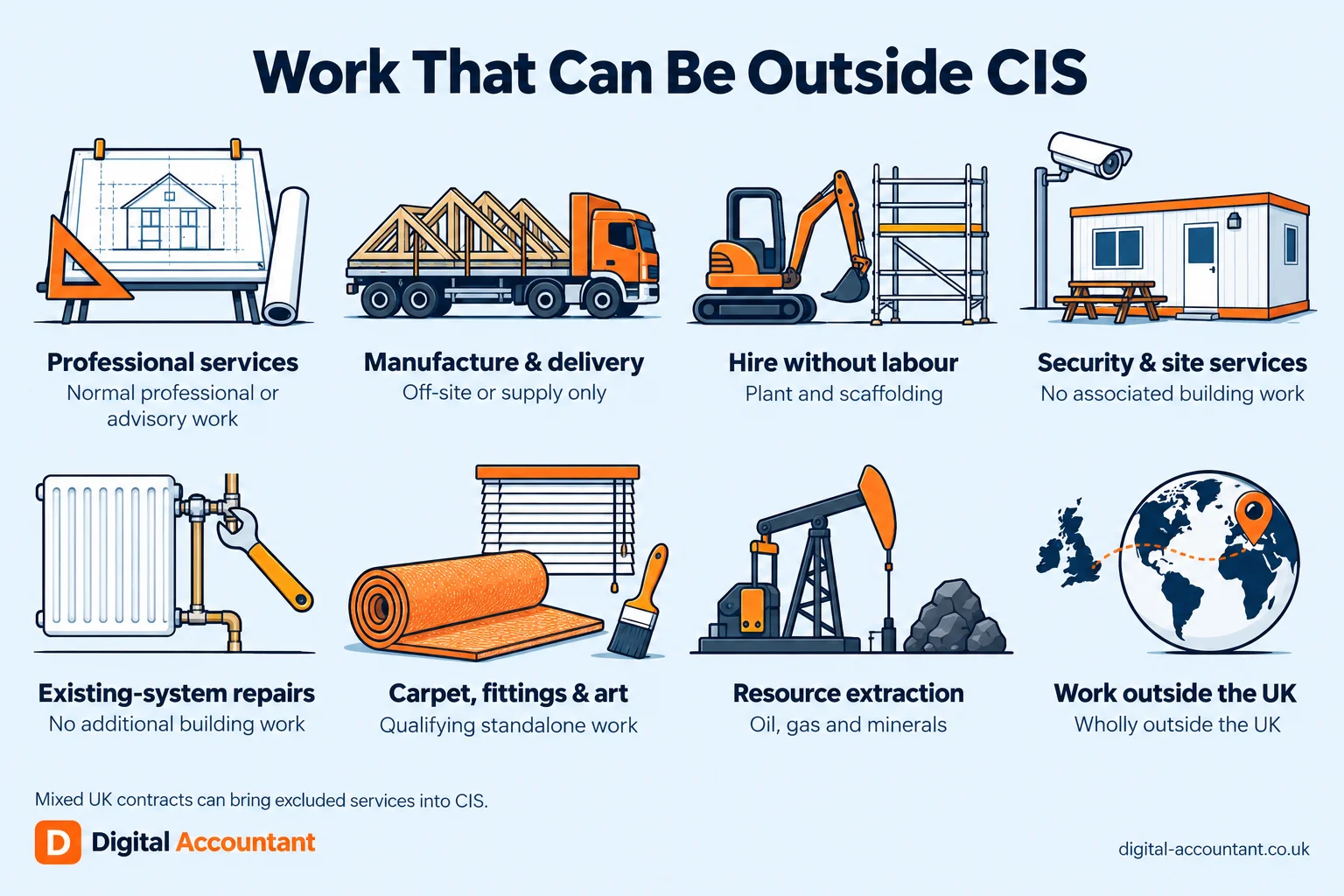
Professional and Consultative Services
Architects and surveyors are excluded for their usual professional services, such as preparing designs or surveying a building. Supervision that forms part of their normal professional role can also qualify.
Consulting engineers and designers are excluded when they only provide advice, assessments, plans or designs. If they also manage construction or supervise the workforce, CIS applies. Architects and surveyors must also check CIS if they take on responsibilities beyond their normal role, such as acting as a developer.
Off-Site Manufacture, Materials and Delivery
If your contract is only to make building components off-site, supply materials or deliver them, CIS does not apply. Examples include making roof trusses, supplying windows or delivering ready-mixed concrete.
If you also agree to install the items, CIS applies to the contract. Delivery to site is excluded, but a separate service moving materials around the construction site is covered.
Plant and Scaffolding Supplied Without Labour
CIS does not apply if you hire out a digger or other construction equipment without an operator. If you also supply someone to operate it for construction work, CIS applies.
Scaffolding hire without labour is also excluded. A contract to put up or take down the scaffolding is covered by CIS.
Security, Site-Facility and Clearly Non-Construction Services
A contract to provide security guards or run site facilities, such as a canteen or toilets, is excluded because these services are not construction work.
A contract just to install burglar alarms or closed-circuit television (CCTV) for security is also excluded. However, if it includes building work, such as constructing concrete posts for cameras, CIS applies to the whole contract. Security fencing and structural doors do not qualify for this security-system exclusion.
Oil, gas and mineral extraction are separately excluded from CIS.
Certain Repairs and Maintenance of Building Systems
A contract solely for repairs or maintenance to an existing plumbing, heating or electrical system is excluded. This includes fixing a leaking pipe or replacing a faulty boiler within an existing system.
CIS applies when you install or replace a complete system, such as fully rewiring a building. It also applies if the repair contract includes building work. For example, a contract to fix a pipe and repair the wall opened to reach it is covered.
Carpet Fitting, Seating, Blinds, Signage and Artistic Work
A contract just to fit carpet or carpet tiles is excluded from CIS. Vinyl or laminate fitting is covered when it forms part of finishing a wider construction project.
Fixed seating, blinds, louvred shutters and qualifying signwriting and signboards are also excluded. Sign installations requiring electrical connections and permanent road signs are covered by CIS.
Purely artistic sculptures and murals are excluded. An item that serves a building function does not qualify for that artistic exclusion. A stained-glass window, for example, still functions as a window.
Construction Work Carried Out Outside the UK
CIS does not apply to construction work carried out wholly outside the UK, even if your business is UK-based. The UK includes its territorial waters up to 12 nautical miles.
This exclusion depends on where the work takes place. An overseas business carrying out construction work in the UK still needs to follow the applicable CIS rules.
Mixed Contracts Can Bring Excluded Work Into CIS
You need to assess the full contract before treating any payment as outside CIS. Work that is usually excluded can fall within the scheme when it forms part of a wider construction agreement.
When One Contract Covers Both CIS and Non-CIS Work
If one contract includes construction work and excluded services, CIS applies to all payments under it. For example, a contract for full electrical rewiring and burglar alarm installation makes both jobs subject to CIS.
Why Separate Invoices Do Not Create a Separate Exemption
A separate invoice for the alarm does not make that payment exempt. Both jobs remain covered by the same contract.
Genuinely separate contracts need individual assessment. The agreements and how the work is carried out must reflect that separation.
No CIS Deduction Does Not Mean the Work Is Exempt
First establish whether CIS applies to the payment, then check whether a deduction is due. Gross payment status, materials and VAT affect the deduction without making the work exempt.
Gross Payment Status Keeps the Payment Within CIS
Gross payment status allows you to receive payments without CIS deductions. Contractors must still verify you when required and include those payments on their monthly CIS returns.
HMRC verification confirms the payment treatment. The usual deduction rates are 20% for registered subcontractors without gross payment status and 30% for unregistered subcontractors. You still declare your business profits through Self Assessment or your company’s Corporation Tax return.
Materials and VAT Reduce the Deduction Base, Not CIS Scope
Before calculating a CIS deduction, exclude any VAT charged and the qualifying cost of materials purchased directly by the subcontractor for that job. Use the actual purchase cost, excluding any profit markup added to the materials charge.
For example, a £1,000 invoice before VAT includes £300 of qualifying materials. The deduction is calculated on the remaining £700, giving a £140 deduction at 20%. The payment is still covered by CIS.
How to Confirm Whether CIS Applies Before You Pay or Invoice
Before paying a subcontractor or issuing an invoice, check the arrangement for the job. Work through these questions to confirm whether CIS applies:
- Who is paying whom, and is the worker self-employed for this job?
- Does the payer qualify as a mainstream or deemed contractor under CIS?
- What work is included in the full contract?
- Does a payment exemption apply, and is HMRC authorisation required?
- If CIS applies, what payment status or deduction rate has HMRC confirmed?
Keep the contract, invoices and evidence supporting any exemption with your records. If you are unsure whether the payment is exempt, call HMRC’s CIS helpline on 0300 200 3210 before treating it as exempt.
You can contact our CIS accountants for guidance on how CIS applies to your work.
Frequently Asked Questions
Does CIS only apply to labour?
No. CIS covers qualifying construction work, including contracts involving both labour and materials. However, CIS deductions are calculated after excluding VAT and allowable costs, such as materials purchased by the subcontractor.
What trades are exempt from CIS?
CIS generally excludes architectural and surveying services, carpet fitting, scaffolding hire without labour, and the delivery of construction materials. However, whether CIS applies depends on the work carried out and the terms of the contract.

Rita writes practical accounting and tax guidance for business owners, drawing on her experience supporting businesses with accounts, tax and financial management.

Bilal reviews our accounting and tax content to ensure it is clear, accurate and aligned with current requirements.