Do You Charge VAT If You’re Not Registered?
No. If your business is not VAT registered, you must not add VAT to your invoices or describe part of your price as VAT. This applies whether you are a sole trader, partnership or limited company.


- Published on:
- 23 October 2026
Table of contents
You can still invoice customers and set prices that cover your business costs. The confusion usually starts when a customer asks for a VAT invoice, a supplier charges you VAT, or your invoicing software adds it automatically. Here is how to deal with those situations and correct any charges made in error.
Why You Cannot Add VAT Without VAT Registration
You must be VAT registered before you can charge VAT on your sales. You cannot add it to your invoices simply because another business charges VAT for the same product or service.
For example, a VAT-registered business charges 20% VAT on a standard-rated service. If you provide that service while unregistered, you invoice for the agreed price without adding a VAT charge.
If you want to charge VAT before registration becomes compulsory, you can register voluntarily. Before deciding, compare the pros and cons of being VAT registered.
VAT applies from your effective registration date, and you need your VAT number before issuing VAT invoices. A plan to register later does not allow you to charge VAT now.
Does Your Customer’s VAT Registration Change the Rule?
No. Your customer being VAT registered does not give your business permission to charge VAT. You still issue an ordinary invoice for the agreed price.
For example, if you agree to a £500 fee for a service, your customer pays £500 with no VAT added. They cannot reclaim VAT from that payment because you have not charged any, even if they normally reclaim VAT on purchases from registered suppliers.
If their accounts team requests a VAT invoice, explain that your business is not VAT registered. Your ordinary invoice can provide the description, price and payment details they need for their records.
Can You Include Supplier VAT Costs in Your Selling Price?
Suppose you buy materials for £100 plus £20 VAT. The materials cost your business £120 because you cannot reclaim the £20 through a VAT return while unregistered.
You also cannot charge VAT on your own sale. You can set your selling price to cover the full £120 cost, but you must not show any part of that price as VAT.
What to Put on Invoices If You Are Not VAT Registered
You can issue an ordinary invoice without a VAT number. It must clearly show what you supplied, who you supplied it to and how much the customer owes.
You can add “Not VAT registered” to explain why there is no VAT charge. Check your invoicing software settings so it does not automatically add VAT or label the document a “VAT invoice”.
Invoice Details and an Example With No VAT Added
Your invoice must include:
- A unique invoice number.
- Your business name, address and contact details.
- Your customer’s name and address.
- The invoice date and the date you supplied the goods or services.
- A clear description of each item and the amount charged.
- The total amount due.
Add your payment terms and payment details so the customer knows when and how to pay.
If you are a sole trader, include your own name and any trading name you use. If you trade under a business name, you must also provide an address where legal documents can be delivered. Limited companies must use their full registered name as shown on their certificate of incorporation.
After adding your business and customer details, a £500 invoice for website design can look like this:
Invoice number: INV-001
Invoice date: 14 October 2026
Supply date: 13 October 2026
| Description | Amount |
|---|---|
| Website design services | £500.00 |
| Total amount due | £500.00 |
Payment terms: Payment due within 14 days.
VAT status: Not VAT registered.
The Difference Between “Not VAT Registered” and “0% VAT”
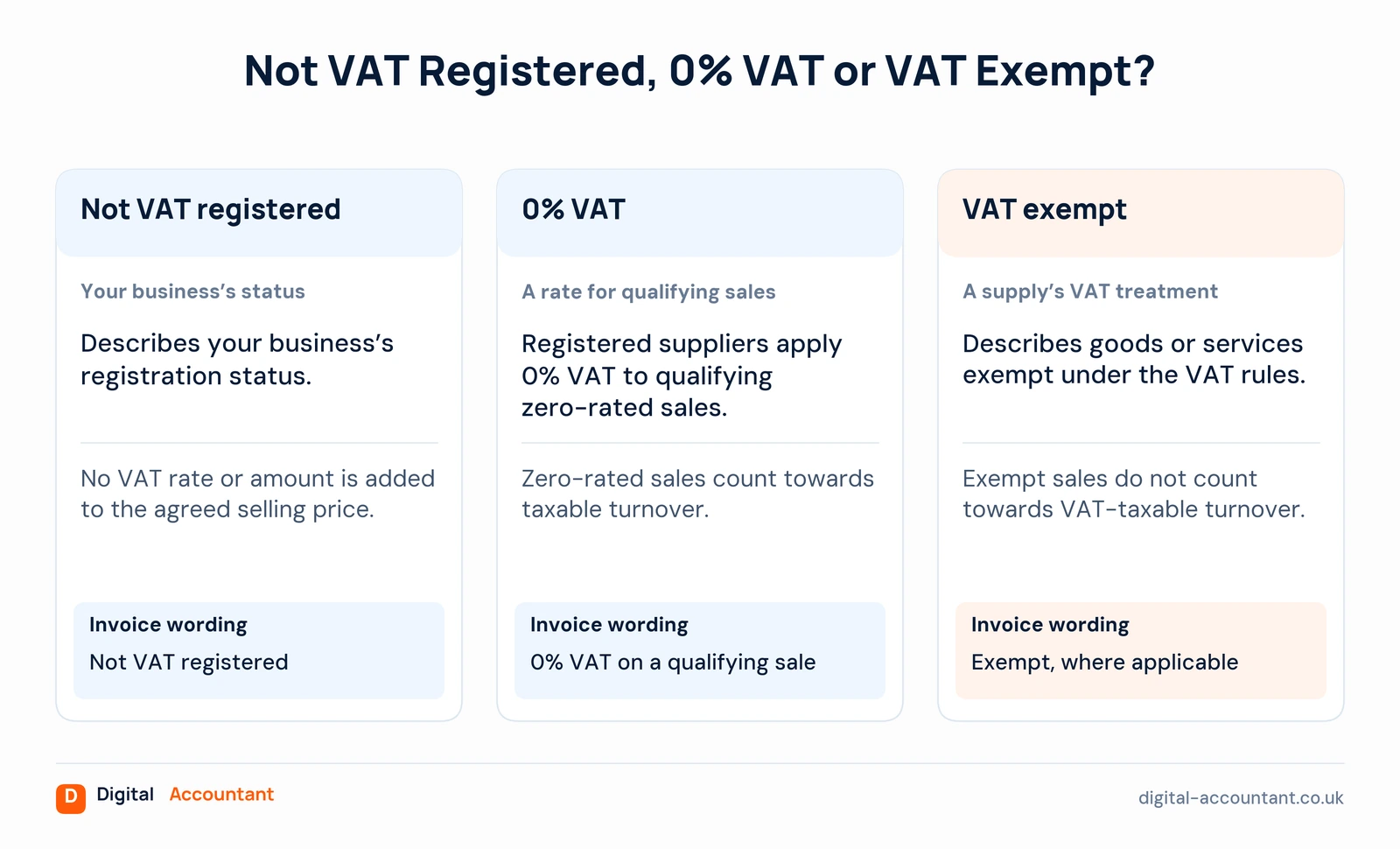
“Not VAT registered” tells the customer about your business’s registration status. “0% VAT” is the rate that applies to qualifying zero-rated goods or services.
A VAT-registered business applies the 0% rate when it makes a qualifying zero-rated sale. These sales are still taxable for VAT purposes and count towards the VAT registration threshold.
If your business is unregistered, you do not apply a 0% rate simply because you have no VAT number. Show the agreed selling price without a VAT rate or VAT amount.
“VAT exempt” has a separate meaning. It describes goods or services that are exempt under VAT rules, such as certain insurance services. Your turnover being below the registration threshold does not make your sales VAT exempt.
What Happens If You Add VAT Without Being Registered?
HMRC can issue a penalty if you add VAT to an invoice without being authorised to charge it. This applies even if the document does not contain all the details required for a valid VAT invoice.
The penalty depends on whether the error was deliberate, whether you took steps to conceal it and how you disclosed it to HMRC. Deliberate and concealed wrongdoing carries a maximum penalty of 100% of the VAT shown. For example, if you incorrectly charge £200 VAT, the penalty can be as much as £200.
A penalty does not apply in every case. HMRC does not charge one for a non-deliberate error if it accepts that you had a reasonable excuse. You must also correct the error without unreasonable delay once that excuse ends.
HMRC can separately require you to pay an amount equal to the VAT incorrectly shown on the invoice. This is in addition to any penalty. Correct the affected invoices and explain the error to HMRC promptly.
How to Correct VAT Charged While You Were Unregistered
If you have charged VAT incorrectly, stop adding it to new invoices. Identify the affected invoices, the VAT amounts charged and whether customers have paid. Before correcting the invoices or issuing refunds, confirm whether your business was already required to register.
Check Whether You Were Already Required to Register
For a UK-based business, VAT registration is normally compulsory when taxable turnover exceeds £90,000 over a rolling 12-month period. You must also register if you expect taxable turnover to exceed £90,000 in the next 30 days alone.
If you register late, HMRC backdates your registration to the correct effective date. You owe VAT on relevant taxable sales from that date, even if you did not charge your customers VAT.
Confirm that date before deciding which invoices to change. Sales covered by your registration need the correct VAT treatment. They cannot be treated in the same way as sales on which no VAT was due.
If you have not registered before, discuss retrospective voluntary registration with your online accountant and HMRC. If HMRC agrees to an earlier start date, you must account for VAT on all relevant taxable sales from that date. Registering now does not automatically make earlier VAT charges valid.
If you are waiting for your VAT number, you must still account for VAT from your effective registration date. You can agree a total price with your customer that covers this liability, but you cannot show VAT separately on the invoice yet. Once your number arrives, reissue the affected invoices with the required VAT details.
Correct the Invoice and Refund VAT Charged in Error
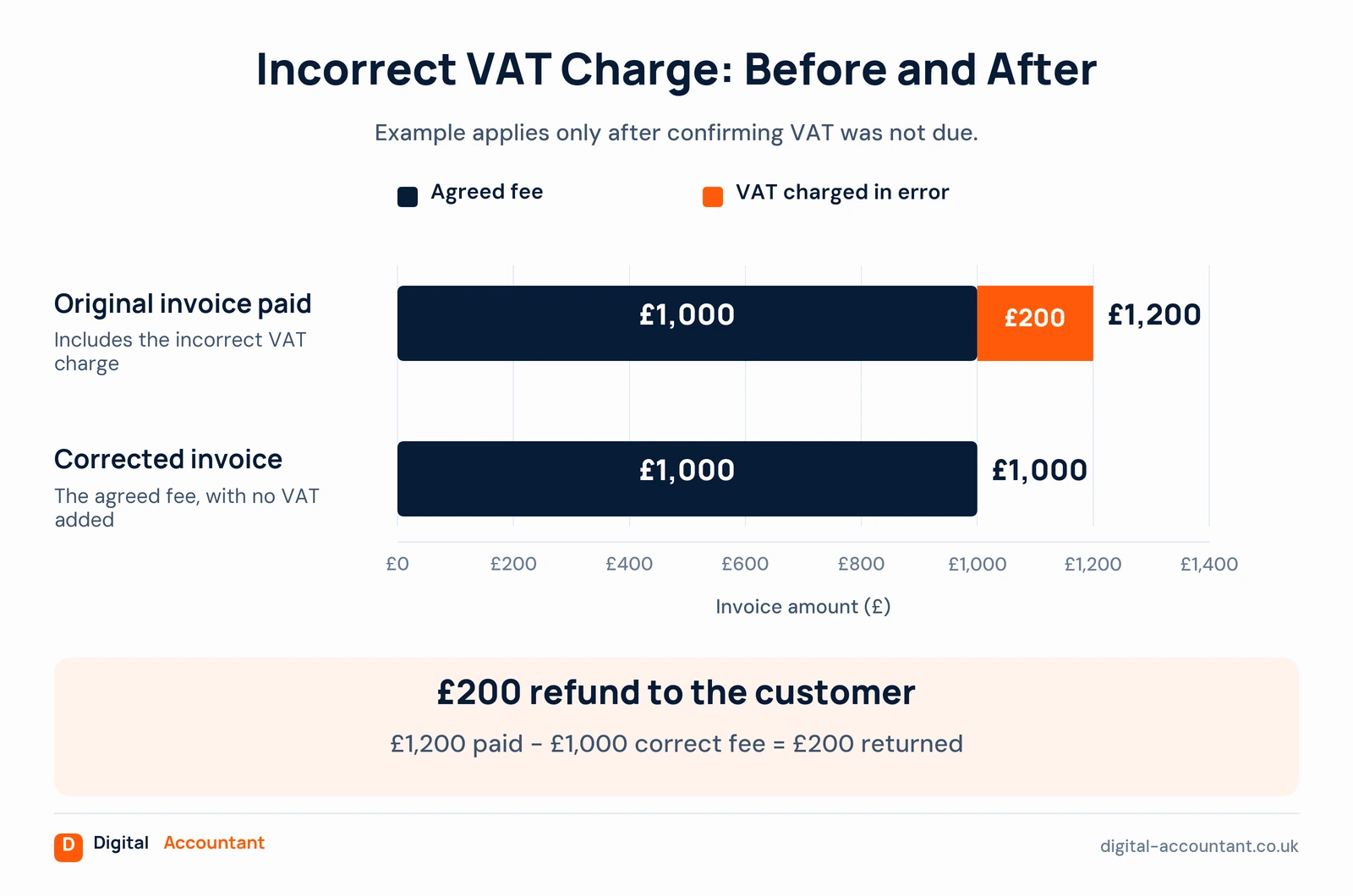
Once you confirm that VAT was not due, issue a credit note to cancel the original invoice. Refer to its invoice number and provide a replacement showing the correct selling price without VAT. Keep the original invoice, credit note and replacement together in your records.
For example, your agreed fee was £1,000, but you mistakenly added £200 VAT and your customer paid £1,200. Credit the original £1,200 invoice, issue a replacement for £1,000 and refund the £200 overpayment.
If the customer has not paid, send the credit note and replacement invoice. Confirm the revised balance and explain which invoice they need to pay.
Explain the Error to HMRC and Affected Customers
Contact HMRC promptly with the affected invoice dates, the amounts incorrectly charged as VAT and an explanation of how the mistake happened.
Explain which invoices you have corrected and which customers you have refunded. Keep copies of the documents and evidence of each refund.
A full, unprompted disclosure and cooperation with HMRC help reduce the penalty within the applicable range. They do not guarantee cancellation.
Tell each affected customer why their invoice has changed and confirm the correct amount payable or refunded.
If they have already reclaimed the incorrectly charged VAT, ask them to review the claim with their accountant and arrange any necessary correction.
Finally, update your invoice template or software settings to prevent the same error. Our accountants for VAT can check your registration position and help you correct the affected invoices.
Charged VAT by mistake, or not sure whether you should be registered? Our VAT accountants can check your position and correct the affected invoices.

Rita writes practical accounting and tax guidance for business owners, drawing on her experience supporting businesses with accounts, tax and financial management.

Bilal reviews our accounting and tax content to ensure it is clear, accurate and aligned with current requirements.