Backdating VAT Registration: How Far Back and What You Owe
You can backdate VAT registration, but the start date depends on whether you register voluntarily or should already have registered. You must account for VAT on taxable sales from that date, even if you did not charge it to your customers.


- Published on:
- 2 November 2026
- Last updated on:
- 6 November 2026
Table of contents
The VAT you can reclaim on eligible business purchases reduces that bill, so check both amounts before you apply.
Can You Backdate VAT Registration, and How Far?
HMRC can give your VAT registration an earlier start date, known as the effective date of registration (EDR). This determines when you must begin accounting for VAT.
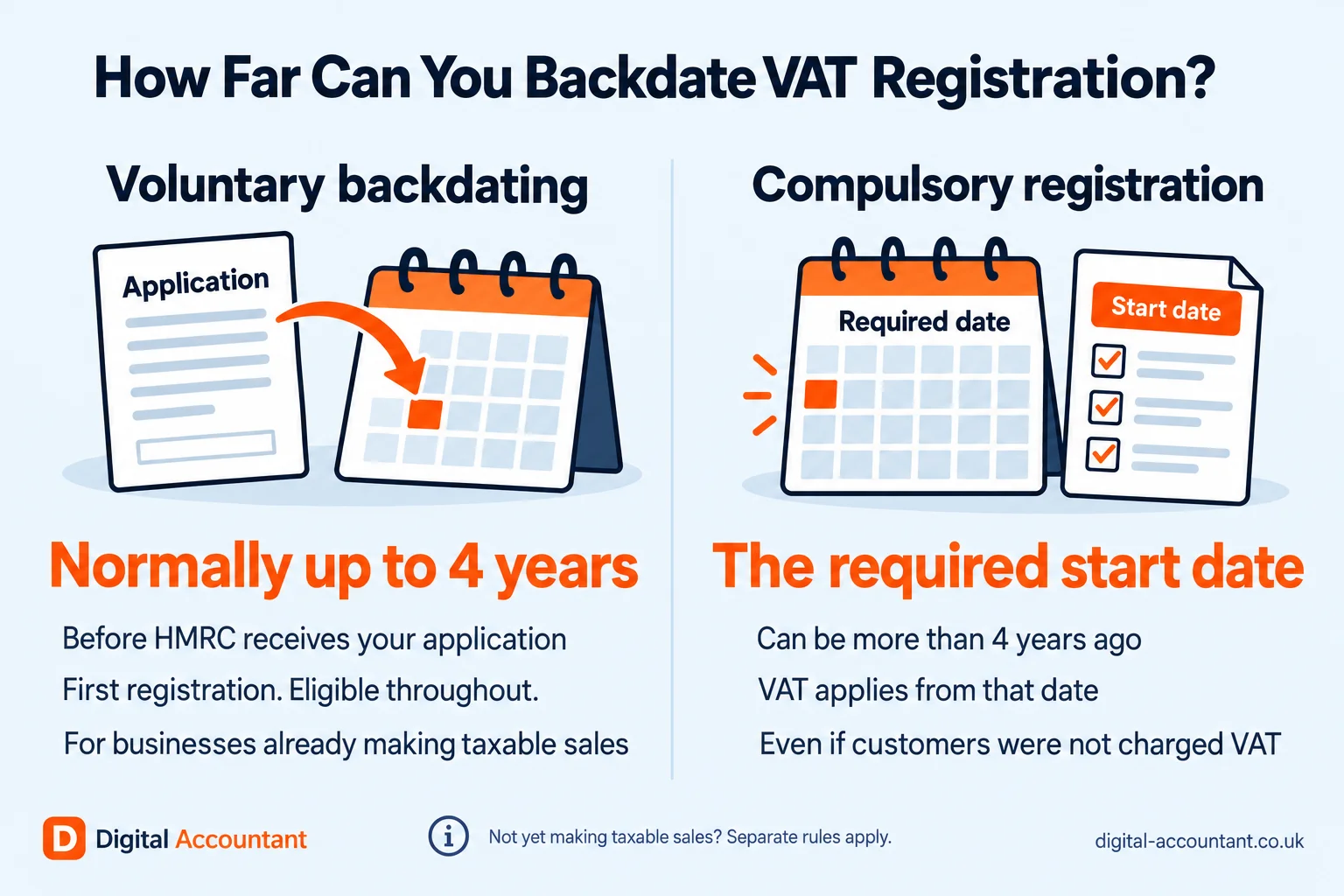
Voluntary Backdating and the Usual Four-Year Limit
If you register voluntarily for the first time, you can normally request a start date up to four years before HMRC receives your application.
Your business must have qualified for VAT registration throughout the period you want to backdate.
This four-year policy applies where you were already making taxable sales.
If you had not started making those sales, HMRC considers your request under separate rules for businesses preparing to make taxable supplies.
The Required Start Date for Compulsory Registration
If your business should already have been VAT registered, HMRC backdates registration to the date it should have taken effect. That date can be more than four years ago because the voluntary backdating limit does not apply to compulsory registration.
You must account for VAT on taxable sales from that date, even if you did not charge your customers VAT at the time.
Which VAT Start Date Applies When You Register Late?
HMRC uses two turnover tests to establish the VAT start date for UK-established businesses. For a late registration, use the threshold that applied at the time. It increased from £85,000 to £90,000 on 1 April 2024.
The Rolling 12-Month Test for Past Turnover
At the end of each month, add up your taxable turnover for the previous 12 months. If you have traded for less than a year, use that shorter period. Include zero-rated sales, but exclude exempt and out-of-scope sales.
For example, if your total first exceeds £90,000 in August 2026, you must notify HMRC by 30 September. Your VAT registration starts on 1 October 2026. This test uses a rolling total, so you must check it each month regardless of when your accounting year ends.
The Next 30 Days Test for Expected Turnover
You must also register if you expect taxable turnover to exceed £90,000 in the next 30 days alone. Your start date is the date you first realise this will happen.
For example, on 10 October, you realise that your taxable sales will exceed £90,000 over the next 30 days. Your registration starts on 10 October. You must notify HMRC within that 30-day period, without waiting for the sales to take place.
How Backdating Affects VAT on Sales Already Made
Review the sales you made from your effective registration date and calculate any output VAT due. The amount depends on each sale’s VAT treatment and the price you agreed with the customer.
VAT Included in Prices You Already Charged
If the agreed price stays unchanged, you normally treat the amount charged as including VAT. You then take the VAT out of that total.
Suppose you charged £12,000 for standard-rated sales during the backdated period. At 20%, the VAT included in that amount is:
£12,000 × 20 ÷ 120 = £2,000
Of the £12,000, £2,000 is output VAT and £10,000 is sales income before other business costs.
When You Can Recover VAT From Past Customers
Check your contract before asking a past customer to pay more. If it allows VAT to be added to the agreed price, request the additional payment. Otherwise, get the customer’s agreement before increasing a fixed total. Their VAT registration alone does not give you the right to charge more.
Once you have your VAT number, issue a valid VAT invoice or supplementary invoice. Show the original supply date and the actual invoice issue date. A VAT-registered customer can reclaim the VAT only if the purchase meets the usual recovery conditions.
If you charge an additional amount, update your sales records and output VAT calculation to reflect the revised total.
What VAT Can You Reclaim After Backdating Registration?
You can reduce your backdated VAT bill by reclaiming VAT on eligible business expenses. The rules for reclaiming it depend on whether the purchase was made before or after your effective registration date.
Purchases Covered by the Backdated Registration
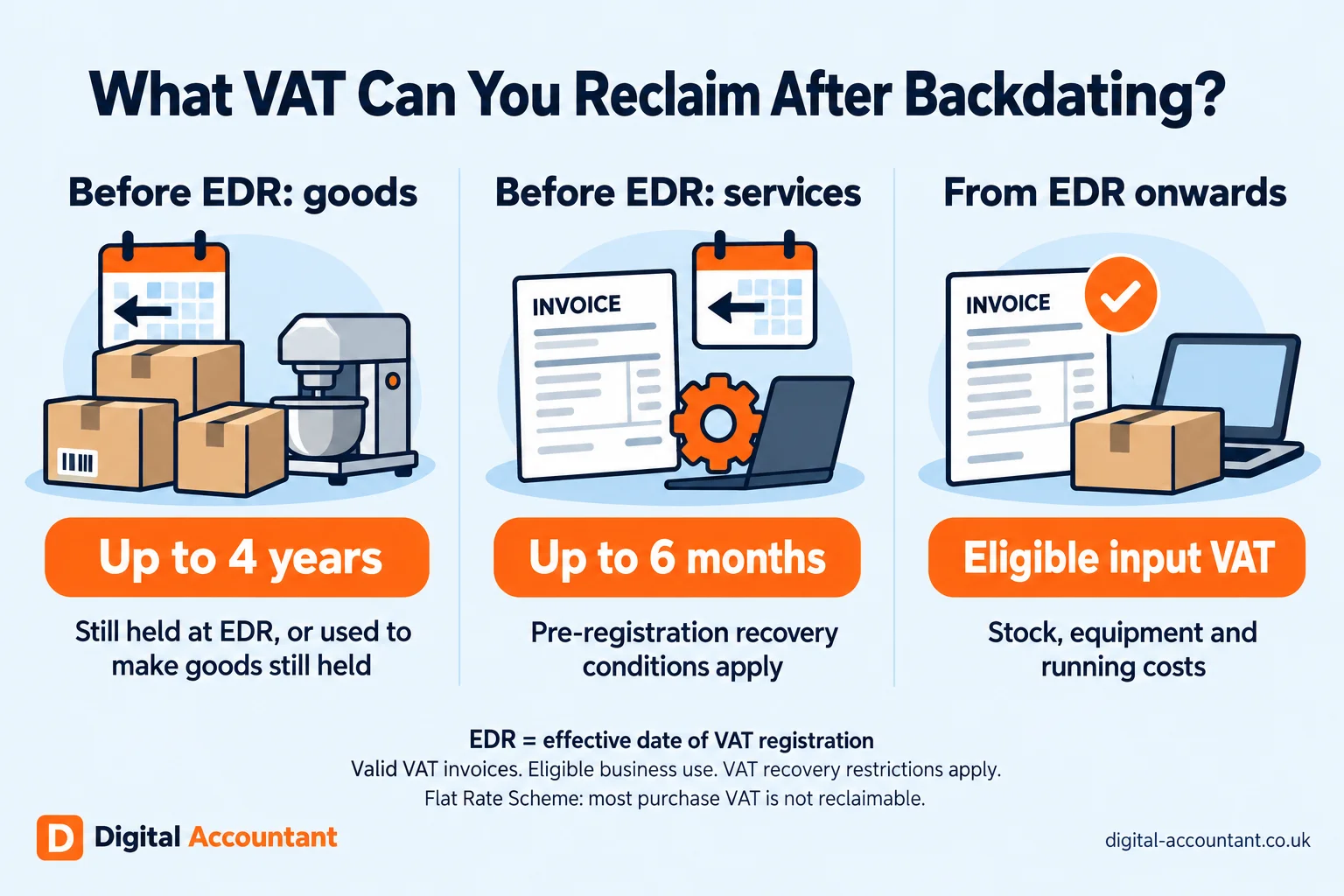
Your backdated registration covers purchases made from your effective date onwards. You can reclaim eligible input VAT on stock, equipment and day-to-day running costs.
You need valid VAT invoices for your claims. Exclude any private-use portion and apply the restrictions on client entertainment and exempt activities. Most purchase VAT cannot be reclaimed under the Flat Rate Scheme.
Eligible Purchases Before Your Effective VAT Date
You can also reclaim VAT on certain purchases made before your effective date. The usual limits are:
- Goods bought within four years before your effective date, provided you still held them on that date, or used them to make other goods you still held.
- Services supplied within six months before your effective date, subject to the pre-registration recovery conditions.
Will Voluntary Backdating Leave Your Business Better Off?
Voluntary backdating leaves you better off when the extra VAT you reclaim is greater than the costs it creates.
These include VAT you must cover on earlier sales and any additional accounting fees. If past customers pay the extra VAT, this reduces the amount your business has to cover.
The comparison must include only VAT you gain by choosing an earlier start date. Some purchases already qualify under the pre-registration rules.
You can reclaim that VAT without backdating, so it does not create an extra saving.
For example, an earlier date allows you to reclaim an additional £3,000 of purchase VAT. It also creates £2,000 of sales VAT that you must cover yourself. This leaves a £1,000 benefit before accounting fees.
If you mainly sell to private customers at fixed prices, VAT on past sales can outweigh the reclaim.
Businesses with substantial eligible purchase costs or zero-rated sales are more likely to benefit. You should therefore compare different eligible start dates before applying.
The longest backdated period does not automatically give you the largest saving.
Can You Move an Agreed VAT Start Date Further Back?
Once you are registered voluntarily, you cannot normally move your agreed VAT start date further back. You need to request an earlier date when you first apply. A larger VAT reclaim identified later is not usually enough for HMRC to change it.
HMRC can still correct a processing error. It can also correct the date if your business should have been registered earlier under the compulsory rules. Requests involving exceptional circumstances are considered individually.
If HMRC overlooked the earlier date you originally requested, provide evidence from your application and ask it to review your request.
How to Apply for Backdated VAT Registration
Before you apply, check the records behind your earlier start date and calculate the VAT due for that period. This helps you submit an accurate application and budget for the bill.
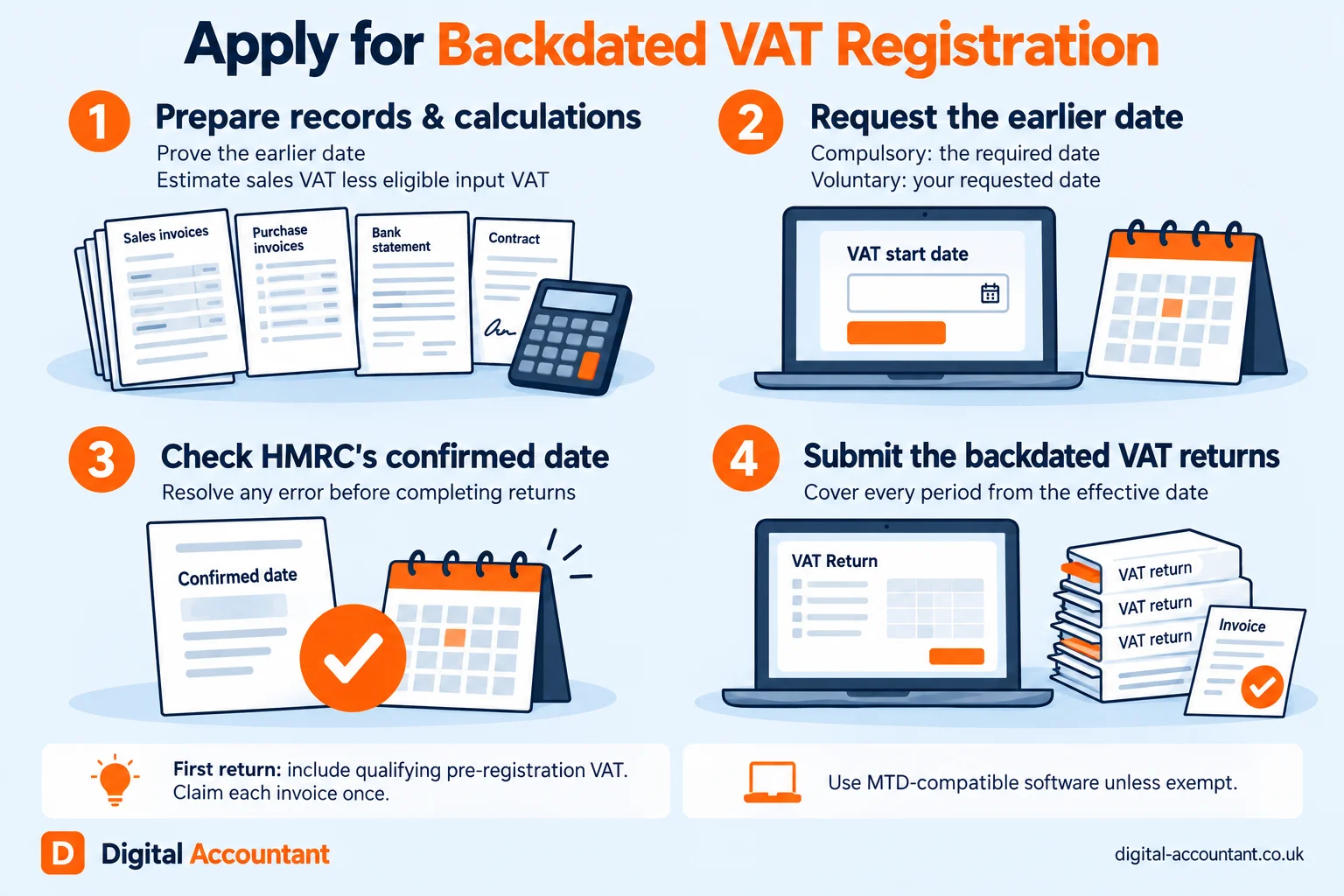
1. Prepare Your Records and VAT Calculations
Your sales and purchase invoices, monthly turnover reports, bank statements and customer contracts provide the starting point. Check supply and payment dates as well as invoice dates to establish when turnover arose.
For compulsory registration, keep a calculation showing when you met the relevant turnover test. For voluntary backdating, your records must show that your business qualified throughout the requested period.
You should also calculate the sales VAT due and identify the purchase VAT you can reclaim. The difference gives you an estimate of the backdated VAT bill.
2. Request the Earlier Date in Your Application
Most businesses can apply through HMRC’s online VAT registration service. Enter the required start date for a compulsory registration. If you are registering voluntarily, request your chosen earlier date.
Provide an explanation and evidence where HMRC asks for them.
3. Check the Start Date HMRC Confirms
When your registration confirmation arrives, check the effective date against your application and any date agreed with HMRC. If it is incorrect, contact HMRC promptly to resolve the error before completing your returns.
4. Submit VAT Returns for the Backdated Period
Your returns must cover the full period from your effective registration date. Use the return periods HMRC assigns and report the sales VAT and eligible purchase VAT for each period.
Include qualifying pre-registration VAT on your first required return. Check the claims against your purchase records to avoid claiming the same invoice twice.
Unless you are exempt from Making Tax Digital for VAT, keep digital VAT records and submit your returns through compatible software.
If you need help checking your start date and preparing backdated returns, speak to our VAT accountants.
Can Backdating VAT Registration Lead to Penalties?
Voluntary backdating does not itself create a late-registration penalty. If you should have registered earlier and missed the compulsory deadline, HMRC can charge a failure-to-notify penalty.
This penalty is separate from the VAT due for the backdated period. HMRC bases it on the net VAT lost after allowable input VAT deductions. Your behaviour and disclosure affect the percentage charged, so you should explain the missed registration promptly and provide the information HMRC requests.
Interest can also apply if VAT for the backdated period remains unpaid after the relevant payment deadline.

Rita writes practical accounting and tax guidance for business owners, drawing on her experience supporting businesses with accounts, tax and financial management.

Bilal reviews our accounting and tax content to ensure it is clear, accurate and aligned with current requirements.