Can I Claim Back VAT as a Sole Trader?
Yes, you can claim VAT back as a sole trader if you are VAT registered and the purchase qualifies under HMRC’s rules. You need evidence of the VAT charged, and the cost must relate to your taxable business activities.


- Published on:
- 4 November 2026
- Last updated on:
- 11 November 2026
Table of contents
VAT on business purchases is called input VAT.
Your VAT scheme and any private use can limit the amount you recover. Here is how to check your purchases before including them in a claim.
How VAT Registration Affects Your Right to Claim
VAT registration is separate from Self Assessment, and the types of sales you make affect your right to reclaim VAT. Here is how those rules apply, including when you can register voluntarily.
Self Assessment Registration Is Separate From VAT
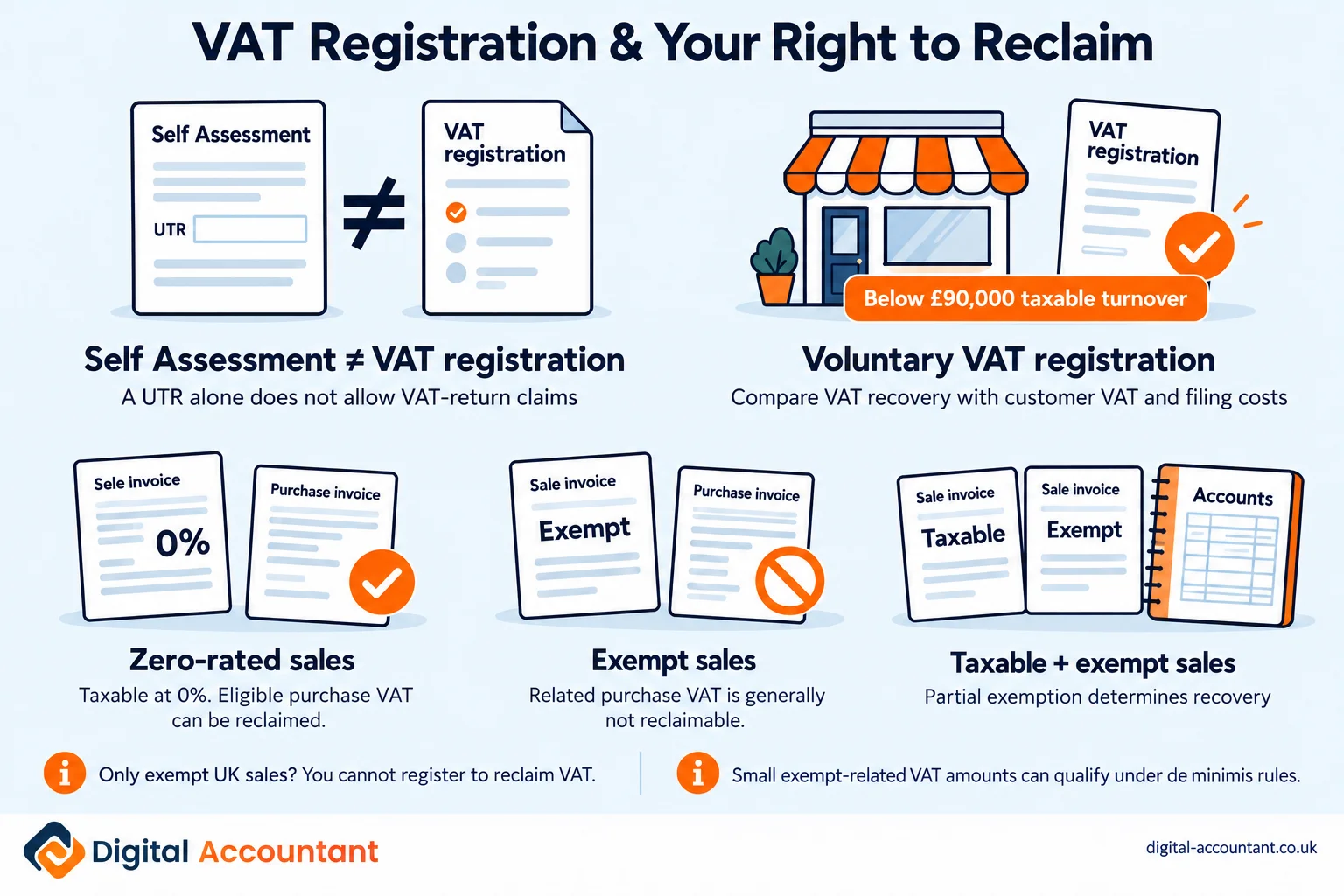
Your Unique Taxpayer Reference (UTR) and Self Assessment registration do not register you for VAT.
If you are not VAT registered, you cannot reclaim purchase VAT through a VAT return. Instead, irrecoverable VAT forms part of your business cost. You may receive Income Tax relief on that cost under the relevant expenses or capital allowances rules.
Voluntary Registration Below the £90,000 Threshold
You can register voluntarily below £90,000. VAT registration becomes compulsory when taxable turnover exceeds £90,000 over a rolling 12 months, or you expect more than £90,000 of taxable sales in the next 30 days alone. The test concerns sales, not profit.
Before registering to recover VAT, compare the reclaim against the VAT you will charge customers and the cost of preparing returns. Customers who cannot recover VAT may face higher prices, or your existing prices may leave you with less income.
Our guide to the pros and cons of being VAT registered explains the wider effect on your prices, costs and cash flow.
Exempt Sales, Zero-Rated Sales and Partial Exemption
Zero-rated sales are taxable at 0%, so a registered business can still recover VAT on related purchases. Exempt sales generally do not allow that recovery.
If you make only exempt UK sales, you cannot register to reclaim VAT. If you make both taxable and exempt sales, partial exemption rules determine your recovery. Some exempt-related VAT can qualify under the small-amount rules known as “de minimis”.
What Can You Claim VAT Back On as a Sole Trader?
Stock, Materials, Tools and Business Equipment
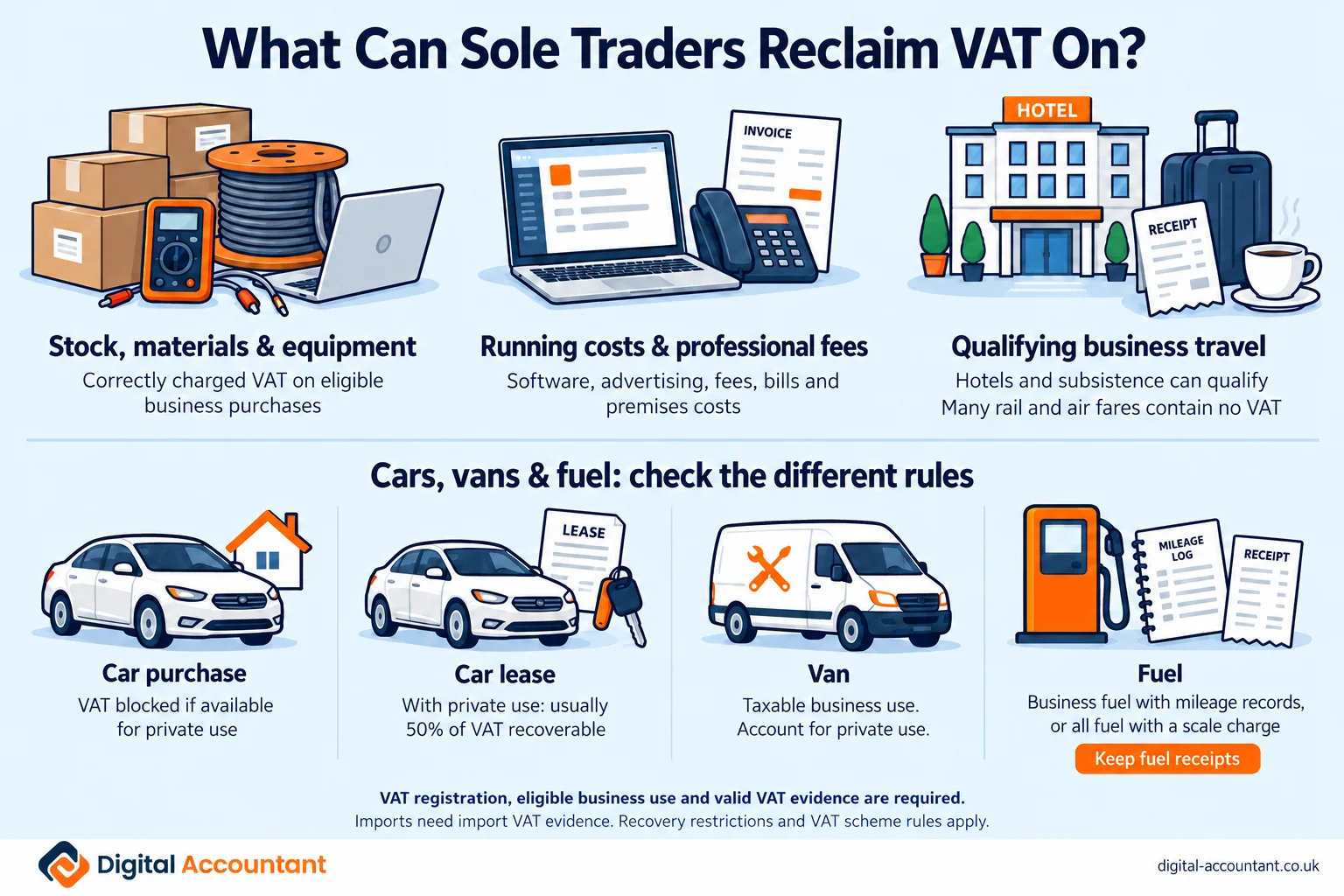
You can usually reclaim VAT on resale stock, materials for customer jobs, tools, computers, machinery and office equipment.
For example, an electrician’s cable and testing equipment can qualify. The supplier must have correctly charged VAT. Unregistered sellers cannot charge VAT, so purchases from them give you no VAT to recover. Eligible import VAT can also qualify with the correct import evidence.
Running Costs, Professional Fees and Business Travel
Eligible costs can include software, advertising, accountancy fees, business legal fees, telephone bills, broadband, utilities and premises costs where VAT is charged.
Qualifying business travel can also include hotel accommodation and subsistence. However, many rail and air fares are zero-rated, so the fare contains no VAT to reclaim. Always check the VAT treatment rather than assuming every business expense includes 20%.
Cars, Vans and Fuel: Different VAT Claim Rules
You cannot reclaim VAT on a car purchase if the car is available for private use, even when most journeys are for work.
You can reclaim VAT on a van for taxable business use, with private use accounted for. VAT on a business car lease with private use is usually 50% recoverable.
For petrol or diesel, you can claim VAT on business fuel using detailed mileage records. Alternatively, you can recover VAT on all the fuel and account for private use through a fuel scale charge. Keep fuel receipts. HMRC’s motoring VAT rules explain the restrictions.
What VAT Can You Recover From Before Registration?
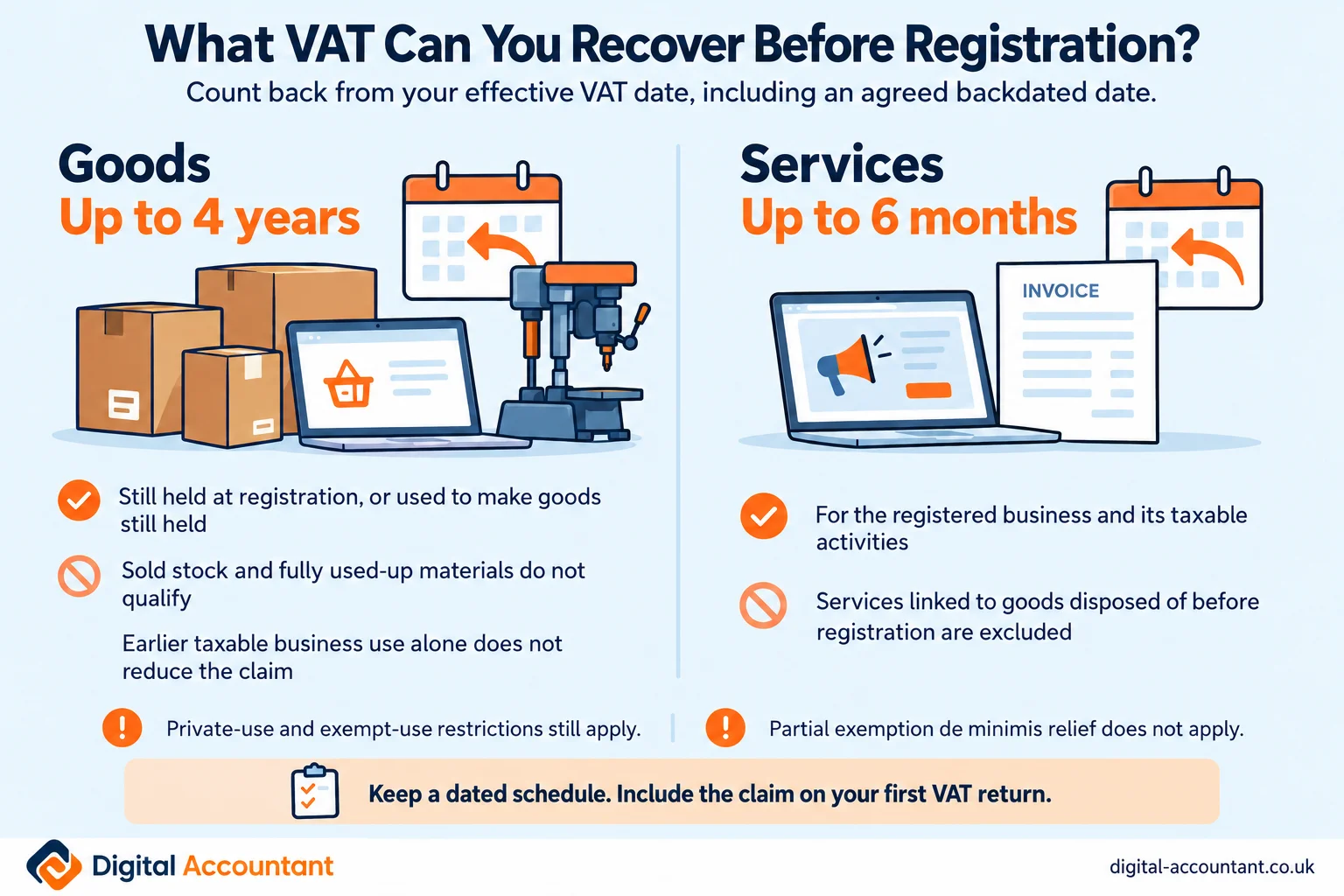
After registration, earlier purchases may qualify under separate rules for goods and services. Their time limits run back from your effective registration date, including an agreed backdated date.
Goods Bought Within Four Years and Still Held
Goods bought for the business within four years can qualify if you still held them when registration took effect. This includes goods used to make other goods you still held.
Stock already sold and materials completely used up do not qualify. For a qualifying machine or laptop, earlier taxable business use does not itself reduce the claim. Private or exempt use still needs separate consideration.
Services Received Within the Previous Six Months
Services received within six months can qualify, such as eligible accountancy or advertising services. They must relate to the business now registered and its taxable activities. Services connected with goods disposed of before registration are excluded.
The partial exemption de minimis relief does not apply to pre-registration VAT.
Keep a dated schedule of eligible goods and services, and include the pre-registration claim on your first VAT return.
Which Costs Are Excluded From VAT Claims?
Some purchases have no recoverable VAT, even when you are registered. These include:
- Purchases entirely for personal use.
- Client entertainment, such as taking customers out for dinner, which is normally blocked.
- Goods bought under a second-hand VAT margin scheme.
- Purchases carrying no VAT, including exempt or zero-rated purchases and goods from unregistered suppliers.
- VAT charged incorrectly by a supplier.
If VAT was charged in error, ask the supplier to correct the invoice. An amount labelled “VAT” does not automatically qualify.
How Much VAT Can You Claim on Mixed-Use Purchases?
For purchases such as laptops and broadband, you can restrict your VAT claim to the business share. Your percentage must fairly reflect business and private use, with records explaining the calculation. The laptop example below shows how that business-use percentage affects your claim.
Example: A £1,200 Laptop Used 80% for Business
Suppose you use standard VAT accounting and buy a laptop for £1,200, including 20% VAT. The invoice contains £200 VAT.
If 80% of its use relates to your taxable business activities, your claim is:
£200 × 80% = £160
The remaining £40 relates to private use. You apply the business percentage to the VAT amount, rather than claiming 20% of the full purchase price.
You can use our reverse VAT calculator to check the VAT included in a purchase price before applying your business-use percentage.
How to Claim VAT Through Your Sole Trader VAT Return
Your claim goes through your VAT return, usually submitted quarterly through Making Tax Digital compatible software unless you have an exemption. The process involves checking your evidence, identifying the correct return period and calculating how the claim affects your VAT bill or refund.
VAT Invoices, Records and Missing Evidence
Keep purchase invoices, receipts and calculations for at least six years. A valid VAT invoice identifies the supplier and VAT charged; simplified VAT invoices can be used for eligible purchases of £250 or less including VAT.
If an invoice is missing, request a duplicate. A bank statement alone is not enough to establish a VAT claim. HMRC can consider alternative evidence in exceptional circumstances, but this does not replace the normal invoice requirement.
When to Claim Under Standard and Cash Accounting
Under standard VAT accounting, you usually claim once the VAT is incurred and you hold the required evidence, even before paying the supplier.
If payment remains outstanding six months after the supply date or payment due date, whichever is later, you must repay the VAT relating to the unpaid amount. You can reclaim it again after payment.
Under the VAT Cash Accounting Scheme, you claim purchase VAT when you pay the supplier.
How Your Claim Reduces Your VAT Bill or Creates a Refund
Enter eligible purchase VAT in Box 4 of your return. It reduces the VAT due on your sales, known as output VAT. Box 5 shows the net amount payable or repayable.
For example, £1,500 of sales VAT less £400 of recoverable purchase VAT leaves £1,100 payable, assuming no other adjustments.
If recoverable VAT exceeds the VAT due, the difference becomes a repayment. HMRC usually makes VAT repayments within 30 days of receiving the return, although checks can take longer.
Our VAT accounting services cover registration, VAT return preparation and checks on the VAT you can reclaim. For help with your wider accounts, bookkeeping and Self Assessment, speak to our accountants for sole traders.
Disclaimer
This article gives general information about UK VAT and does not replace advice tailored to your business. VAT recovery depends on your circumstances and the evidence for each purchase. Tax rules and HMRC guidance can change, so check the current requirements or speak to an accountant before making a claim.
Not sure which purchases you can claim VAT back on? Our VAT accountants can check your claims and prepare your returns.
FAQs About Sole Trader VAT Claims
Is it worth being VAT registered as a sole trader?
Registering for VAT as a sole trader can be worthwhile if you have significant VAT to reclaim and mainly sell to VAT-registered businesses. Compare that benefit with the effect on your prices, margins and accounting costs.
How does VAT work for sole traders?
Once you are VAT registered, you charge VAT at the correct rate on taxable sales and can reclaim VAT on eligible business purchases. Under standard VAT accounting, if you charge customers £500 VAT and can reclaim £200 on purchases, you pay HMRC the £300 difference. If the VAT you can reclaim exceeds the VAT due on sales, you can claim a refund.

Rita writes practical accounting and tax guidance for business owners, drawing on her experience supporting businesses with accounts, tax and financial management.

Bilal reviews our accounting and tax content to ensure it is clear, accurate and aligned with current requirements.