VAT Penalties for Late Registration: What HMRC Can Charge
If you missed your VAT registration deadline, HMRC can charge a penalty as well as the VAT you owe. You must account for VAT from the date you should have registered, even if you did not charge it to customers.


- Published on:
- 11 November 2026
Table of contents
VAT penalties for late registration range from 0% to 100% of the net VAT due for the penalty period. The percentage depends on why you missed the deadline, when HMRC becomes aware of the problem and how fully you cooperate. If you disclose the failure promptly and provide complete records, the penalty can be reduced.
What Are the Current VAT Penalties for Late Registration?
HMRC can charge a failure-to-notify penalty if you miss your VAT registration deadline. These rules are set out in Schedule 41 of the Finance Act 2008.
HMRC calculates the penalty as a percentage of the net VAT due for the penalty period. This is separate from the penalty-points system for submitting VAT returns late.
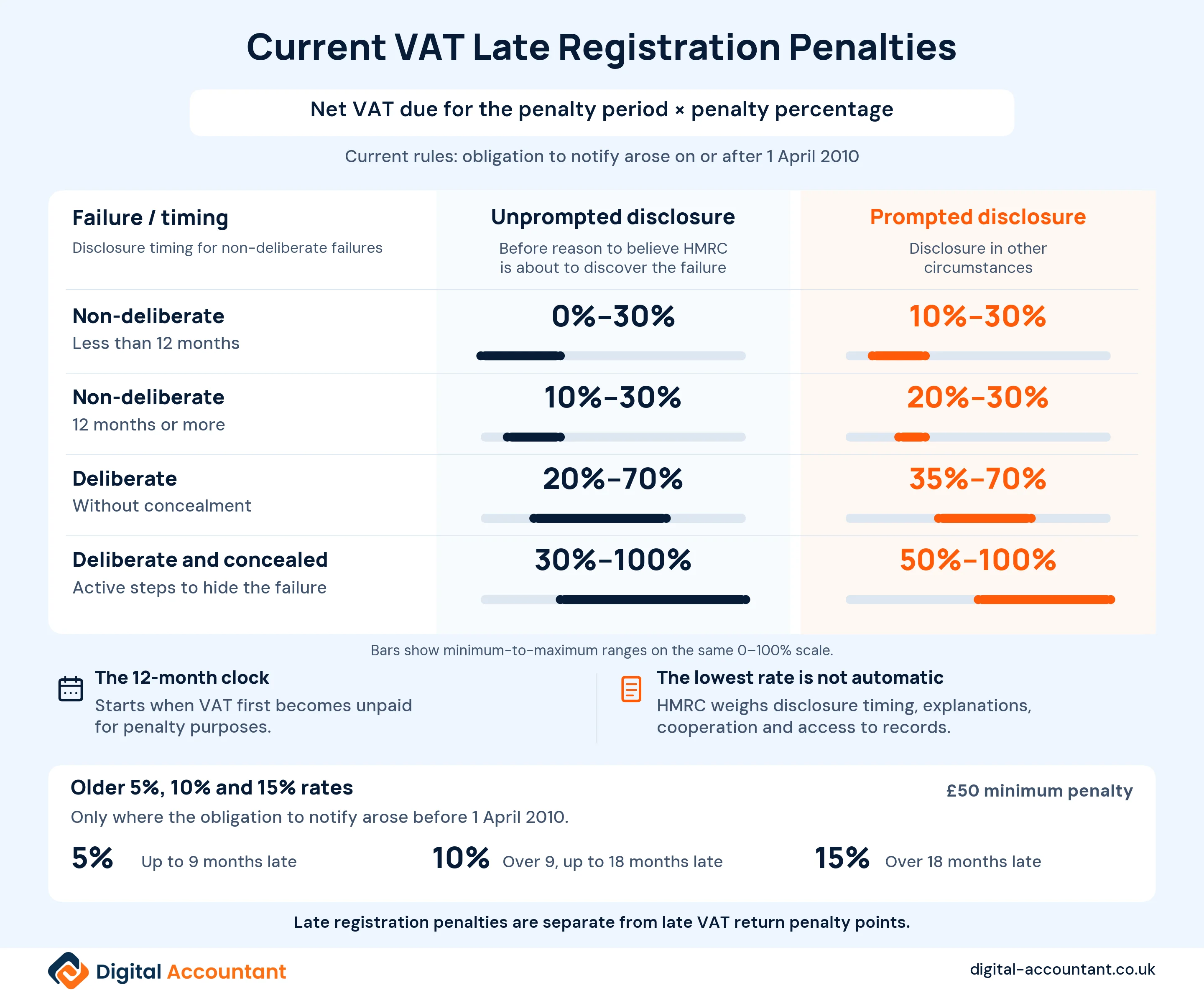
Penalty Ranges for Non-Deliberate and Deliberate Failures
A non-deliberate failure means you missed the notification deadline unintentionally. A deliberate failure means you knew you had to tell HMRC but chose not to. If you also took steps to hide the failure, HMRC treats it as deliberate and concealed.
Your disclosure also affects the penalty range. Unprompted disclosure means telling HMRC before you have reason to believe it is about to discover the failure. A disclosure made in other circumstances is prompted.
| Failure and disclosure timing | Unprompted disclosure | Prompted disclosure |
|---|---|---|
| Non-deliberate: less than 12 months | 0%–30% | 10%–30% |
| Non-deliberate: 12 months or more | 10%–30% | 20%–30% |
| Deliberate, without concealment | 20%–70% | 35%–70% |
| Deliberate and concealed | 30%–100% | 50%–100% |
For non-deliberate failures, the 12-month period starts when VAT first becomes unpaid for penalty purposes.
The lowest rate in each range is not automatic. HMRC considers how promptly and fully you explain the failure, help establish the correct VAT and provide access to records.
When the 5%, 10% and 15% Penalty Rates Apply
The percentages in VAT Notice 700/41 belong to the older penalty system. They apply where the obligation to notify HMRC arose before 1 April 2010:
- 5% if registration was no more than nine months late.
- 10% if registration was more than nine months but no more than 18 months late.
- 15% if registration was more than 18 months late.
The minimum penalty under that system is £50. If your notification obligation arose on or after 1 April 2010, HMRC uses the current failure-to-notify rules instead.
How Is Your Late VAT Registration Penalty Calculated?
HMRC first calculates your potential lost revenue (PLR). This is the net VAT liability arising from your failure to notify. It then multiplies that amount by the penalty percentage that applies to your circumstances:
Potential lost revenue × penalty percentage = late VAT registration penalty
The VAT Amount and Period Used in the Calculation
The penalty period starts on the date you should have been registered for VAT. It ends on the date HMRC receives your notification or otherwise becomes fully aware that you should be registered, whichever happens first. A delay in issuing your VAT number does not extend this period.
You must account for VAT on taxable sales from that start date, even if you did not charge it to customers. Where the agreed price includes VAT, you calculate the VAT within that amount.
For example, a £1,200 VAT-inclusive sale at the standard 20% rate contains:
£1,200 ÷ 6 = £200 VAT
How Recoverable Input VAT Reduces the Penalty
The VAT you can reclaim on eligible business purchases reduces the amount used to calculate your penalty. Check that all qualifying purchase invoices for the penalty period have been included. Leave out VAT you cannot reclaim, including the portion relating to private use.
Some purchases made before your effective VAT registration date also qualify. The usual limits are:
- Goods: purchases made up to four years before that date, provided you still hold the goods or used them to make other goods you still hold.
- Services: qualifying services received up to six months before that date.
Measure these limits from the effective date, rather than your application date.
Worked Example: How Disclosure Changes the Penalty
Suppose the penalty period includes £10,000 VAT on sales and £4,000 VAT you can reclaim on purchases:
£10,000 − £4,000 = £6,000 potential lost revenue
Assume the failure was non-deliberate and disclosed within 12 months of VAT first becoming unpaid for penalty purposes. If HMRC allows the maximum disclosure reduction:
- Unprompted disclosure: £6,000 × 0% = £0 penalty.
- Prompted disclosure: £6,000 × 10% = £600 penalty.
The £6,000 VAT bill remains payable in both cases. Your disclosure changes the penalty added to it.
What If No Net VAT Is Due for the Penalty Period?
If the VAT you can reclaim equals or exceeds the VAT due on sales for the penalty period, potential lost revenue is nil. The percentage-based failure-to-notify penalty is then £0.
You still need to register and submit any required VAT returns.
Paying an outstanding VAT bill after discovering the missed registration is different. That payment settles the VAT debt, but it does not, by itself, remove a penalty. HMRC still considers the VAT liability for the original penalty period.
How Can You Reduce or Avoid a Late Registration Penalty?
Act promptly once you realise your VAT registration is late. HMRC considers when you disclose the problem, why it happened and how fully you help establish the correct VAT bill.
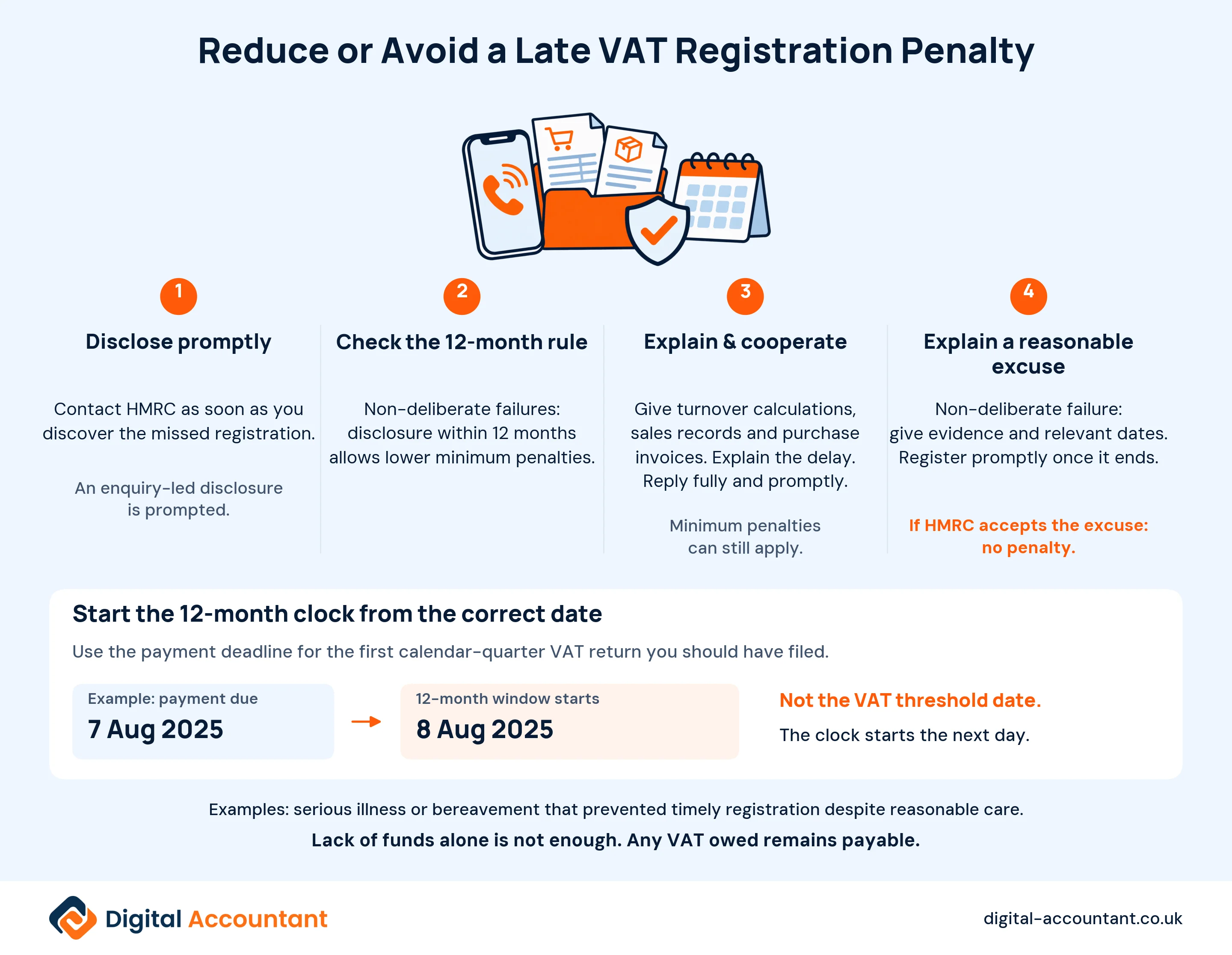
- Contact HMRC as soon as you discover the missed registration. If an HMRC enquiry leads you to report it, your disclosure is prompted.
- For a non-deliberate failure, disclosure within 12 months allows lower minimum penalties. Find the payment deadline for the first calendar-quarter VAT return you should have filed. The 12-month window starts the following day. For example, suppose payment was due on 7 August 2025. The window starts on 8 August 2025. Do not count from the date you crossed the VAT threshold.
- Explain why registration was late. Provide your turnover calculations, sales records and purchase invoices. Answer HMRC’s questions fully and respond promptly. Your cooperation affects the reduction available. It does not automatically remove a minimum penalty that applies to your case.
- HMRC can remove the penalty if it accepts a reasonable excuse for a non-deliberate failure. You must also register promptly once the excuse ends. Serious illness or bereavement can qualify if it prevented timely registration despite reasonable care. Explain what happened and provide evidence, including the relevant dates. Being unable to afford the VAT is not enough on its own. Any VAT owed remains payable.
How to Disclose and Correct Late VAT Registration
- Check when you first became required to register. Use the threshold and rules that applied at that time. The current threshold for a UK-established business is £90,000.
- Confirm your VAT registration date. For the rolling 12-month test, identify the month your taxable turnover exceeded the threshold. You had 30 days from that month-end to apply. Registration starts on the first day of the second month after you crossed the threshold. Different dates apply under the next-30-days test. Registration starts when you first expected turnover to exceed the threshold within those 30 days alone. You must apply by the end of that period.
- Apply promptly and explain the delay. Enter the correct registration date and explain why your application is late. Keep a copy of your application and explanation. Do not delay registration while collecting purchase invoices.
- Prepare your backdated VAT return. Calculate VAT on sales from your registration date. Deduct the input VAT you are entitled to reclaim. Keep the invoices and records used for these calculations.
- Pay by HMRC’s deadline. If you cannot pay in full, contact HMRC about a Time to Pay arrangement. Overdue VAT can lead to interest and separate late payment penalties.
If you have missed your VAT registration deadline, our VAT accountants can check your start date, prepare your backdated returns and deal with HMRC for you.
How to Challenge a Late VAT Registration Penalty
HMRC should explain how it calculated your penalty. Compare that explanation with your records before accepting the amount.
Checking HMRC’s VAT Figure and Penalty Assessment
Check that HMRC has:
- Used the correct registration date and penalty-period end date.
- Included all input VAT you are entitled to reclaim.
- Correctly assessed your behaviour and whether your disclosure was prompted.
- Applied the 12-month rule and any penalty reductions correctly.
Explain any errors and provide evidence showing the correct position. Also raise any reasonable excuse or reduction HMRC has overlooked.
Requesting a Review or Appealing Within 30 Days
You normally have 30 days from the decision letter to accept HMRC’s offer of a review or appeal to the First-tier Tribunal. Follow the instructions in your notice.
If you choose a review and disagree with its outcome, you normally have a further 30 days from the review conclusion letter to appeal to the tribunal.
Frequently Asked Questions
How much is the penalty for late filing of VAT?
If you pay in full within 15 days of the due date, there is no late payment penalty. If you pay between 16 and 30 days late, the penalty is 3% of the VAT unpaid on day 15. If you pay 31 days or more late, a further 3% applies to the VAT unpaid at day 30, and an additional penalty builds daily from day 31 at 10% a year on the unpaid balance. HMRC also charges interest from the first day your payment is overdue.
What happens if I forget to register for VAT?
You must pay any VAT owed from the date you should have registered. This applies even if you did not charge your customers VAT. HMRC can also charge a late registration penalty.

Rita writes practical accounting and tax guidance for business owners, drawing on her experience supporting businesses with accounts, tax and financial management.

Bilal reviews our accounting and tax content to ensure it is clear, accurate and aligned with current requirements.